7th January 1938
BROSELEY
CHILDREN'S FANCY DRESS. A fancy dress dance for children was held at the Town Hall, on Saturday. The organising committee were Mrs. Davis (chairman), Mrs. Broadhurst, Mrs. H. Watkins, Mrs. Smith and Miss Lister. Mr. J. Jones was doorkeeper, and the Rev. C. S. Jackson (rector), was M.C. The judges were Miss Lister, Mr. Dennis Cope, Mr. Campbell and Mrs. Boden. The prizewinners were 1 Betty Bradley (tea), 2 Ivy Hall (Irish Girl), 3 Margaret Millward (Robin Hood), 4 Nora Hough (Peace), 6 Joan, Queen with attendant page (Alan Jones), 7 Turley Oakley (Bavarian peasant); boys —1 Trevor Instone (traffic signals), 2 Guy Tonkiss (old fashioned cricketer), 3 Billy Hough (Dick Whittington), 4 George Mason (Black Cat), 5 Graham Whitmore (drummer boy).
DEATH OF MRS. HURDLEY. —The death occurred at Walsall of
Mrs. Clara Hurdley, widow of Mr. George Hurdley, once the Broseley cricket
captain. The funeral was at
FUNERAL OF MR. JOHN ROPER.—The funeral took place at
OLD PEOPLE ENTERTAINED.—About 65 old people were entertained at the Methodist Schoolroom on Wednesday. Those unable to walk were conveyed to and from the building in cars lent by Mrs. F. C. Howells and Mr. Haydn Burns, The party was organised by the Sunday School, with Mr. E Harris and Mr. E. Humphries as secretaries. Tea was catered for by the teachers of the Sunday school.
Broseley Playing Field
Chapel Plan Before Council
At a meeting of Broseley District Council on Wednesday, Alderman A. A. Exley (vice-chairman) presiding, the Clerk (Mr. F. W. Derry) announced that the Ministry of Health had provisionally sanctioned the sewerage scheme, which was the subject of the recent public enquiry at Broseley.
A letter was received from the Broseley Society for the Prosecution of Felons, stating that they were pleased to learn that the Council had acquired the Birch Meadow playing fields. While they were sure that this public ground would prove of great benefit and pleasure, particularly to the younger folk, they felt that its value would be increased by suitable buildings, providing dressing rooms for those taking part in football and other games, and ventured to suggest that the Birch Meadow Chapel was the ideal building for this purpose. With this in view, the Society passed a resolution at a special meeting, on December 13, containing the following:— "That the Society offer to the local authority a sum not exceeding £100 for the purchase, of the chapel, with the earnest hope that the building will be converted by them as a physical fitness centre, in conjunction with the playing field adjoining." The letter was signed by Mr W. E. Price, secretary.
Councillor T. W. Howells moved that the matter he deferred for one month. His sole reason for doing so was the absence of the chairman, who was keenly interested in the matter. It was an important and rather large subject, and as no time limit was fixed by either sellers or purchasers, nothing would be lost by leaving it over
This course was agreed upon.
The clerk reported the receipt of a letter from the National Playing Fields Association, in reply to the Council's letter applying for a grant for the Birch Meadow Field. They stated that the Government's physical fitness fund was the likeliest one from which the Council would obtain help.
The Clerk said that one of the conditions for obtaining a grant front this fund was that a definite lay-out plan and scheme of equipment must be submitted when asked for.
Councillor Howells said he was going to suggest that at the next meeting a sub-committee should be formed to draft a scheme, embodying the field and the building. His proposal that this matter be also deferred for one month, was carried.
It was resolved to send to Alderman J. Nicklin (chairman) an expression of sympathy in his illness, with hopes that he would have a speedy recovery.
NOTICE TO QUIT
It was resolved to give the tenants of three Council houses notice to quit, unless their rent arrears were paid by the following Saturday.
The Sanitary Inspector (Mr. C. T. Thomas) reported two
houses, one in Simpson's Lane and one in
It was resolved to write to the owner of the other house asking him if he objected to demolition.
A proposition to have one-way traffic in
14th January 1938
JACKFIELD
FUNERAL OF MRS. J. JONES.—The funeral took place on
Wednesday of Mrs. Rose Jones, of Lloyd's Head, who died on Saturday, aged 73.
She was a native and well-known resident of Jackfield, and was the widow of Mr.
John Jones, an old employee of Messrs. Craven, Dunnill, who died 15 years ago.
A service at the
BROSELEY
METHODIST PARTIES.—Through the kindness of Mrs. F. C. Howells (Field House), the officers and trustees of the church, Sunday school teachers, members of the choir, and their wives were entertained to tea on Wednesday at the Methodist Schoolroom, which was gaily decorated. Supporting Mrs. Howells were Councillor and Mrs. T. W. Howells, Master Trevor Howells, the Rev. and Mrs. R. H. Osborne, the Rev. E. W. A. Barber, the Rev. C. S. Jackson (Rector of Broseley), Mr. J. G. Broadhurst, Mrs. James Davies, Mr. C. R Jones. (Sunday School superintendent). Mr. A. O. Jones was M.C. for the evening, and Mr. Dennis Williams was the pianist. Master Trevor Howells organised competitions, the winners being Mr. C. O. Jones, Miss Edna Williams, Mr. Fisher and Mrs. C. S. Thomas. Games and community singing were included in the programme. Tea was served by lady members of the church. Yesterday (Thursday) Mrs. F. C. Howells entertained the senior scholars of the Sunday school to a party. Mr. A. O. Jones directed games. Father Christmas was impersonated by Mr. Jack Sankey, and each child had a present.
DEATH OF MISS M. POOLE. — Deep sympathy has been extended to
Mr. and Mrs. T. W. Poole,
CONSERVATIVE TEA. — The annual tea party of the women's
branch of the Conservative Association was held at the Town Hall on Friday,
about 50 people being present. In the absence of Lady Nora More, the
vice-chairman (Mrs. George Potts) presided, others present including tile Mayor
of Wenlock (Councillor E. H. H. Shorting), and Miss Foster (hon. divisional
women's organiser). The helpers were: Mrs. Potts, Mrs. Renwick, Mrs.
Broadhurst, Mrs. Parr, Miss Lister, Mrs. T. Instone, Mrs. Evans and Mrs.
Pountney. Games, dances and a concert followed, songs being given by Miss F. L.
Roberts, Miss Barbara Jones (
SOCIAL. — About 100 people were present at the church social
at the Town Hall on Saturday. The Rev. C. S. Jackson and Mr.
21st January 1938
Broseley Church
----
PROSPECTS OF A SENIOR SCHOOL
Rector's Fears
The Rev. C. S. Jackson, Rector, presided at last night's annual church meeting at the Town Hall, Broseley. He nominated Mr. H. Baysfield as vicar's warden, and the Mayor of Wenlock, Mr. E. H. H. Shorting, was elected people's warden.
The statement of accounts, presented by Mr. W. Andrews, treasurer, showed total receipts of £355 4s. 8d., of which £60 1s. 9d. was the result of the gift day, and the remainder made up of church collections. There was a balance in hand of £4 is. 4d.
The treasurer stated that collections were down by £7, and had it not been for the gift day and a single donation of £11 there would have been a considerable adverse balance. The accounts were passed with thanks to the treasurer. The Town Hall accounts showed receipts of £134 13s. 3d. and expenditure of £139 13s. 4d., giving an adverse balance of £15 2s. 1d. Mr. C. F. Francis said it appeared to be necessary to revise the whole scale of charges. Several of the expenses would not occur again, but independent of that the letting fees the Town Hall was receiving would not allow the account to balance on the right side. The matter was referred to the Town Hall Committee.
The Church Council were re-elected, and Mr. W. H. Stone and Mr. D. Cope were added to the list of sidemen.
Representatives for the Ruridecanal Conference were re-elected, and the Rector stated that the Wenlock Ruridecanal Conference had been held recently
The Broseley representatives were not notified individually and a resolution had been passed by the Church Council protesting against the short notice given and the infrequency of the conferences.
The Rector made a statement regarding a meeting which had
taken place that clay between the Broseley school managers and the Secretary of
Education for
When he went away, said the Rector, he said he agreed with them in aim and principle, but not from the practical point of view. The Rector said he was afraid that in a short time a new school would be built at Wenlock. If they had 200 senior children in Broseley they might build a school, but they had only 186. Should this scheme materialise he was afraid they would be asked to spend at least £1,000 in reconditioning the existing school, and making it into a junior school.
The meeting resolved, on the motion of Mr., A. J. Garbett,
seconded by Mr. H.
The meeting resolved that in the event of the Birch Meadow Chapel being found to be suitable for the general physical development of the town, to urge the Broseley Council to go forward. This was moved by Mr. H. Darlington, seconded by Mr. H. Watkins, and passed by a small majority.
It was resolved to communicate with the appropriate public bodies asking that the Rectory Corner streets widening scheme might be proceeded with.
28th January 1938
BROSELEY
FUNERAL OF MRS. JOHNSTON The funeral took place en Wednesday
of Mrs Mary Ann Johnston, of the Post Office, Broseley Wood, who died on
Satarday, aged 75. She was a native of
WOMEN CONSERVATIVES. — The annual meeting of the women's branch of the Conservative Association was held on Wednesday, Lady Nora More was re-elected chairman, and at Easter, when she is leaving the district, Mrs. Rowland Hunt will succeed her. Other officials elected were: President, Lady Forester; vice-chairman, Mrs. George Potts; secretary, Mrs. Renwick; assistant secretary, Mrs. A. Jones; treasurer, Mrs. P. W. Parr. Vice-presidents were re-elected with the addition of Mrs. Benthall (Benthall Hall). An address was given by Major E. R. H. Herbert.
MOTHERS' UNION PARTY. The two oldest members of the Benthall
branch of the Mothers'
TENNIS DANCE. — There was a good attendance at the annual dance of the Broseley Tennis Club at the Town Hall on Wednesday. Mr. Walter Davis was secretary and M.C. Refreshments were served by lady members of the club. A Bridgnorth band played. Dance prizes were presented by Mrs. W. Howells to Mr. and Mrs. J. Shaw. The room was nicely decorated, the stage being bordered with evergreens.
SPECIAL COURSE FOR TEACHER —Mr. S. R. Brooks, a teacher at Broseley Boys' School, who left on Monday for Borough Road College, Isleworth, London, was one of six teachers selected by the County Education Committee for a special three months' course in physical training. In the meanwhile Mr. Brooks' place will be taken by Mr. W. Clay (Whitchurch).
Iron-Bridge Police Court
At Iron-Bridge Police Court on Tuesday William Morris, livestock buyer, 10, Elm Road, Birkenhead, was summoned for quitting a motor car without having, first stopped the engine, at the Wharfage, Iron-Bridge, on January 4.
P.C. Brooks said he waited by the car for three minutes while the engine was running until Morris came out of some business premises. He told witness that there was a lot of traffic about and he did not hear the engine.
Morris was ordered to pay the costs (4s.).
Ernest Ralphs, labourer, 35, Wenlock Road, Buildwas, was summoned for riding a bicycle on the footpath at Dale End, iron-Bridge, on January 11.
P.C. Boardman said Ralphs rode on the footpath past a shop doorway and when approached by witness he admitted having made a tyre mark 36 feet long on the footpath.
Ralphs wrote asking for lenient treatment stating that his cottage was damaged in the recent gale and had been put to expense.
He was finead 5s., including costs.
LICENSING BUSINESS
The full transfer of the Shakespeare inn, Coalport, was granted to Miss E. M. Heighway from the late Mr. Frederick Heighway.
Mr. J. Slatter, The Cuckoo Oak, Madeley, was granted an occasional licence from 10 p.m. until 2 a.m. for the ball in aid of the Shropshire Constabulary Benevolent Fund at the Anstice Memorial Hall on January 28.
Mr. A. G. Oswell, The Lion Hotel, Broseley, was granted an extension of one hour until 11 p.m. for the Posenhall Football Club dinner on February 1.
Mr. H. E. Rowley, The Talbot, Iron-Bridge, was granted an extension of one hour until 11 p.m. for the Iron-Bridge Comrades Club dinner on February 4 and the Iron-Bridge Angling Club dinner on. February 12.
The magistrates were: The Mayor of Wenlock (Coup. E. H. H. Shorting), Lord Forester, Alderman W. Bishop, Alderman W. Roberts, Mr. C. H. Parker and Mr. J. S. Barker.
4th February 1938
Posebhall Football Club Dinner
Presentation to Secretary
At a dinner and smoking concert in connection with the
Posenhall Rovers Football Club, at the Lion Hotel, Broseley, on Tuesday, Mr. E.
Wilde was presented with a bureau in recognition of his services as secretary
and treasurer for the past ten years. The Rev. C. S. Jackson (Vicar of
Benthall), presided, and was supported by Mr. C. O. Dyas (President), Mr. J. W.
Jones (Little Wenlock), a member of the Shropshire F.A. Council; and Mr. H. B.
Skitt (secretary, Shropshire F.A.), Mr. R. Latham (secretary,
The presentation was made by Mr. C. O. Dyas, who said that Mr. Wilde had given wonderful service to the club. He had done the secretarial work, and arranged the teams and transport; he had been treasurer and had seen to the receipts and payments. He had spent many hours each week during the season on the club's business, and hardly knew when he had finished. Had it not been for Mr. Wilde, the club could not have gone on. Apart from the weekly football, he had organised a weekly club, at which indoor games were played to keep the members together in a friendly and social way. No other club in the country had a secretary who was willing to give up his time in a voluntary capacity more than Mr. Wilde.
Mr. Wilde, in response, said what he had done for the club, he did with a good heart and he had no regrets for the time he had spent.
EXAMPLE OF "STICKING IT "
The toast of the Posenhall Football Club was proposed by the Rev. C. S. Jackson, who said that while "Mr. Jackson's" teams in Broseley had come and gone, Posenhall had gone on and on. The club never seemed to have any public appeals. They were self-supporting, self-managing and self-disciplined and had set a wonderful example of "sticking 'it." He joined with the tribute which had been paid to Mr. Wilde. The club had done great work, and he believed it would be called upon to do even greater work by being linked up with the physical fitness movement.
Mr. S. Colley and Mr. L. Sanger replied, thanking Mr. Jackson and the Benthall Church Council for the use of the club's dressing room.
The Rev. C. S. Jackson proposed the toast of "Football," welcoming the representatives of the Football Association. In all the difficulties of running junior football clubs they knew they had a real friend and sympathiser in Mr. Skitt. (Hear, hear).
Mr. H. B. Skitt said he agreed with the Rev. C. S. Jackson
that the new physical fitness movement should be linked up with the national
game of football. More village clubs were now springing up and he believed this
was due to better management of competitions. The standard of refereeing was
also improving. He was happy to mention Mr. A. Fielding, of Broseley,
officiated as linesman in an important match between First Division clubs at
Mr. J. W. Jones, who also responded, said the former Little Wenlock side always enjoyed their meetings with Posenhall.
Mr. R. Latham said Posenhall had been a credit to the Wellington League. They had never had a misconduct case while they had played in registered football. The chairman thanked the licensee (Mr. Oswell). Mr. Wilde thanked the Rev. S. Jackson of presiding, and Mr. L. Sanger thanked the lady helpers. Mr. A Fielding thanked the club for the invitation given to referees. The health of the President was drunk with musical honours, and Mr. Dyas replied that so long as he had the farm he would he glad to see the club playing on his field.
The lady helpers were Mrs. Oswell, Mrs. Reeves, Mrs. Wilde (mother of the club secretary), Mrs. Anthony, Mrs. Colley; Miss Oswell, and Mrs. Heath. The artistes were thanked by Mr. C. O. Dyas.
In a long musical programme the main feature was the "hill-billy " songs and popular hits, given in " western " costume by Mr. R. Johnstone, with guitar accompaniment, including the song " Little Buckree," which he broadcast in the "In Town To-night " programme, about six weeks ago. Mr. E. Wilde showed his versatility by contributing humorous monologues and a duet with Mr. A. Anthony. Others contributing songs were Messrs. C. Wilde and G. Wilde (duet), Walter Watkins, D. Potts, A. Bishton, A. Fielding and A. Cartwright, with Mr. J. Harrison as pianist.
80th Birthday Gift for Mr. Nickiln
Senior Wenlock. Alderman
Alderman J. Nicklin, senior Alderman of the Borough of Wenlock, and chairman of the Broseley Ward Council, was given a silver tray after the meeting of the Broseley Council on Wednesday, to mark his approaching eightieth birthday. Owing to Alderman Nicklin's absence from the meeting through illness, the gift was exhibited prior to being taken to him and bore the inscription "Presented to Alderman J. Nicklin, J.P., C.C., on the occasion of his eightieth birthday, as a mark of esteem and regard, by the Mayor, Town Clerk, and his colleagues in the Broseley Council, February 7, 1938." Alderman A. A. Exley (vice-chairman) presided.
Councillor T. W. Howells said the gift was offered to Alderman Nicklin as an expression of their regard for his services to the Council. Unfortunately owing to continued indisposition, it was not possible for him to be there. He was voicing the thoughts of the Council in wishing Alderman Nicklin a speedy recovery to health, and a quick return to help them in the Council chamber. During the last three years there had been very troublesome matters to deal with, but the fact that they had been dealt with in such a harmonious spirit was due to the tactful leadership of Alderman Nicklin. Those of lesser municipal experience looked to him for help and guidance. He always unhesitatingly gave them a lead and his judgments were sound. They felt they could not allow the occasion to pass without some memento of his services. He was one of the four senior members of the Wenlock Town Council and was the senior alderman.
The Mayor of Wenlock (Councillor E. H. H. Shorting), intimated that he had seen Alderman Nicklin, and he asked him (the Mayor) to convey to the Council his grateful thanks for the gift. There was nothing he would have liked better, and he would always appreciate it.
The chairman said he supported everything that had been said.
The Town Clerk (Mr. F. W. Derry) said Alderman Nicklin had been a member of the Borough Council for 34 years. He had served as Mayor, and had been a justice of the peace for twenty years, and was the fourth senior magistrate of the Borough. He was also a member of the County Council and of the Wenlock Guardians' Committee. He had practically devoted his life to public social and philanthropic work.
A letter of thanks was read from Alderman Nicklin, in which he said I want to convey a message of heartfelt and sincere expression of my deepest gratitude for such a beautiful gift. I am deeply touched by your great kindness. I value the knowledge that I have the kindly and wholly sincere friendship of all my colleagues."
JACKFIELD—BROSELEY
MIGRATION
Councillor P. W. Parr said two tenants of two houses in Jackfield had complained to him that they were to be moved to new houses at Broseley, one under the overcrowding and one under the slum clearance scheme.
Councillor. T. W. Howells: We can't find any suitable housing Sites in Jackfield. That is why we are forced to take them to Broseley.
"We can't find a Jackfield site," said the chairman.
The Sanitary Inspector (Mr. C. J. Thomas) said there were four houses in Jackfield from which the occupants had to be rehoused.
Councillor Parr: If we were moved from Broseley to Jackfield we should probably have something to say about it.
The Clerk : If I was moved from Jackfield to Broseley I don't think I should have anything to say about it.
Councillor Parr: These people are being moved further away from their work.
It was decided to take no action.
The Surveyor (Mr. F. Richards) reported that Speed's Lane could be resurfaced at a cost of £294, and could be made fit for foot passengers at a cost of £75.
The matter was adjourned to the next meeting.
The
BIRCH MEADOW CHAPEL The Clerk said the question of the purchase of the Birch Meadow Chapel and the whole outlay of the Birch Meadow playing field had been deferred from the last meeting because of the chairman's absence.
Alderman Exley: I think the best thing is for a small committee to go and see what can be done.
Councillor T. W. Howells: We are not supposed to look a gift horse in the mouth, but I suppose we have got to do it. Before we commit ourselves, I think a small committee ought to review the position and see what use can be made of the playing fields, and what use can be made of the Birch Meadow Chapel in conjunction with the playing fields. I think we have to have some sort of pavilion or shelter. Is this shell offered us going to be useful for that purpose? It will mean the whole inside being taken out. We ought to find what it would cost to put it in repair.
The Mayor raised the question of a grant and the Clerk said no grant could be obtained until the scheme was formulated, and it was stated what money it was proposed to expend.
Councillors C. R. Jones, W. Davies, P. W. Parr and the Surveyor (Mr. F. Richards), were appointed a sub-committee to investigate and report upon the matter.
Mail Order Club Dealings
Woman Charged With Fraud
COMPLAINTS BY
CUSTOMERS
Iron-Bridge
Bench
Grant Legal Aid
At a special court at Iron-Bridge Police Station, on Monday, Mrs. Sarah Jane Hollins (32), 33, Sutton Common, Shifnal, was committed for trial at the next Wenlock Quarter Sessions on the two following charges of fraudulent conversion.
The charges were:—(1) That being entrusted with £1, the money of Mrs. Mary Annie Lewis, of Barrow, Broseley, to purchase goods from the Littlewood's Mail Order Stores, Ltd., she did fraudulently convert the same to her own use, between March 27, 1937, and December 30, 1937; and (2) that being entrusted with 9s, the money of Mrs. Lillian Williams, of Barrow, for a similar purpose, she converted the same to her own use between March 27, 1937, and January 2, 1938.
Mrs. Hollins pleaded "Not guilty " to the charges,
and was represented by Mr. C. K. Mynett (Messrs. Littlewood and Peace,
Mrs. Mary Annie Lewis, 28, Barrow, Broseley, said about two years ago Mrs. Hollins came to live near to witness at Barrow and she started to run a 1s. club. Witness had eight weekly shilling shares in it. Mrs. Hollins ran the club satisfactorily and witness had her goods each week as they became due. On March 27, 1937, Mrs. Hollins began to run another club. Witness had twelve shares in it. Mrs. Hollins gave witness the six cards (produced). The cards were marked with the weeks. Witness took the 1st, 2nd, 9th, 10th, 13th, 14th, 15th, 16th, 17th, 18th, 19th and 20th weeks' chances.
The entries were made on the cards, and the last one was crossed out, because witness refused to pay. She refused to pay because the 9th chance was overdue. The first chance was a pair of flannel trousers.
Mrs. Hollins left in April to live at
CORRESPONDENCE WITH FIRM
Witness told Mrs. Hollins to get lady's clothing to the value of £1. Witness did not receive anything. She saw Mrs. Hollins on June 22 and asked why she did not get the goods. Mrs. Hollins said she was in trouble with the club and witness would have to wait. At this time witness had paid £5 8s. and received goods to the value of £2. 'Witness communicated with the proprietors of the club, and had ten letters from them.
Witness also wrote to Mrs. Hollins, after a representative of the Stores had called to see her. In September she received goods from Littlewoods consisting of lady's clothing value £1, a bed chair value and two table cloths value 8s. Having previously received goods value £2, she had up to then received goods value £4 8s. from Mrs.. Hollins, and had paid her £5 8s. Witness wrote to Mrs. Hollins and asked her to order four shirts to the value of £1. Witness received no answer and she complained to the firm. They wrote and told witness to put the matter in the hands of the police.
On January 5 Mrs. Hollins came to see witness, and offer to give her but she refused, saying the matter was in the hands of the police. Witness did not know whether she had a pound or not.
In reply to Mr. Mynett, witness said Mrs. Hollins contended that she had sent this £1 to Littlewood's. Mrs. Hollins' husband came to collect money three times, and his visits were towards the ninth week.
METHOD OF BUSINESS
Robert McNabb,
UNABLE TO COLLECT MONEY
John Farnsworth, investigator employed by the Stores, said Mrs. Hollins was the organiser of club No. 239,937. When complaints were received from the witness, Mrs. Lewis, he interviewed Mrs. Hollins on Monday, August 16, and asked why she had not forwarded the orders of Mrs: Lewis, She stated that she had only collected the club money from the members for nine weeks. Witness asked why and she said when she had called on the members she was unable to get the club money, and as she then resided about seven miles away, she could not afford the expense of calling on them. Witness told her she would have to call on the members and collect the club money, but she stated that she did not intend to do so. Witness told her that if she did not forward the outstanding orders of the member, Mrs. Lewis, that the consequences would be serious. She informed witness that Mrs. Lewis had twelve shares in the club. She had paid £5 8s. and had only received £2 value of goods. Witness saw Mrs. Lewis and she mentioned to witness that some members were in arrear with their payments. One member had received goods value £2 and had only paid £1. Another member had received goods value £1 and only paid in 9s.
Mr. Mynett : These clubs run well so long as the members pay their contributions. Supposing members default; the organiser if he or she has no capital is landed " in the cart? "
Witness: Certainly. She has her own redress. She can sue them in the county court.
Mrs. Violet Annie Humphries, 29, Barrow Cottages, Broseley said she joined Mrs. Hollins' club at the end of March, 1937, and had two 1s. shares, getting the 5th and 6th weeks' chances. Mrs. Hollins collected her payments until May 22. Witness should have received some goods at the beginning of May, and not receiving them witness wrote to the firm. She had given Mrs. Hollins an order for an oil stove, value £2. Witness produced her card on which she had paid 20s. She identified a receipt (produced) from Littlewood's, acknowledging the receipt of a further £1 which she sent to the firm.
Mrs. Lucy Beatrice Grainger, Arlescote Farm House, Broseley, said she joined Mrs. Hollins' club on March 29, 1937. She had one share and it was the eighth week chance. Mrs. Hollins collected her shilling regularly until May 24. Through Mr: Hollins, who came in place of his wife, witness ordered a linoleum square to the value of £1. Witness did not get it so she wrote to the firm and received it about three weeks later. She produced the card, showing payments of 9s. She sent this card and a remittance of 12s. to pay for the linoleum square.
STATEMENT TO POLICE
P.C. Ogilvie said he received information of the case from Mrs. Lewis on December 30, 1937. After obtaining a statement from Mrs. Lewis, together with the club cards and correspondence produced, witness and Inspector Machin interviewed Mrs. Hollins on January 4 with regard to Mrs. Lewis'complaint that there was £1 outstanding. She said "I have sent all the money I have taken to Littlewood's." Witness showed her the six cards (produced) relating to Mrs. Lewis' contributions, and asked her if the signatures were her own. She agreed that they were, and she admitted having collected 12s. a week front Mrs. Lewis between March 27 and May 22. She insisted that she had sent on the money collected. She stated that she had some receipts, but these were stored with her furniture at the Hay Farm, Madeley, and beyond her informing them the names of the club members were Mrs. Lewis (twelve shares), Mrs. Williams (one share), Mrs. Humphries (two shares), Mrs. Grainger (one share), herself (one share), her father, Mr. Groves (one share), her husband (two shares), the police could get no satisfactory explanation. Witness cautioned her and told her she would be reported for fraudulently converting to her own use the sum of £1 received from Mrs. Lewis. Witness offered her writing materials. She said I am not writing anything. If they take me to the police court I will say what I have to say there. I can't contradict myself there. I am not going to any court. I will send to Littlewoods what I owe." Mrs. Hollins signed this statement.
When charged with the first offence, Mrs. Hollins pleaded “Not guilty” and reserved her defence. Mrs Hollins was committed for trial at the Wenlock Sessions to be held on April 30.
CUSTOMER WHO GOT NOTHING Mrs. Lillian Williams, 39 Arlescote
Cottages, Broseley, giving evidence
in the second case, said that in March, 1937 she agreed to have a shilling
share in Mrs. Hollins’ club. She paid her first shilling on March 27, and she
had the 11th week chance. Mrs. Hollins resided at Barrow until the middle of
April and then went to
Robert McNabb said he received a letter from the last witness complaining of the non-receipt of goods. The firm referred the complaint to the organiser. No order for goods had been received from the last witness.
John Farnsworth said when he interviewed Mrs. Hollins on August 16, she admitted that her member, Mrs. Williams, had paid the sum of 9s. without return, and she (Mrs. Hollins) intended to refund the money.
P.C. Ogilvie said he interviewed Mrs. Williams and received from her the card and correspondence (produced). On January 4 witness interviewed Mrs. Hollins and asked her to examine the club card of Mrs. Williams. She admitted having received the nine shillings and said she had sent Mrs. Williams' order to Littlewoods, but had enclosed no money with it. Witness told her she would be reported for fraudulently converting to her own use the sum of 9s. received from Mrs. Williams for the purpose of purchasing goods. Mrs. Hollins said "I have had the money from her. I have sent it to Littlewoods. All the money I have had from members I have sent to Littlewoods. The whole trouble is my husband’s suit. If I had sent the money up for that I would be all right now. I owe Littlewoods something about 32s. It may not be that much. I have sent Mrs. Williams' order up but not the money. The reason I have not sent it up is because I have a county court bill to pay, and am having to go out to work all day myself to help to pay my way. "Mrs. Hollins signed this statement. She then commenced to cry and produced two county court judgment summonses, one for about £12, another for about £2 together with receipts showing that she was paying it off in amounts ranging from 5s. to £1, and said " What can't speak can't lie."
LEGAL AID GRANTED
Mr. Mynett made an application for a defence certificate, granting legal aid. Although the amounts involved were comparatively trivial, he said, by its very nature the charge was a serious one. The charges arose out of a mistake of 29s. and occurred while Mrs. Hollins was conducting one of Messrs. Littiewood's clubs. To a woman of the position of Mrs. Hollins the running of the club was a complicated 'matter and required. The keeping of complicated accounts. In this case fraud was the essential element. Their worships might not think that Mrs. Hollins was a fit person to run a club, but the element of fraud had to be proved. At the Quarter Sessions there would he prosecuting counsel, and it would he in the interests of justice that there, should be defending counsel and instructing solicitors to put the case fairly before the court. Her husband was a farm labourer earning 34s. a week. Mrs. Hollins worked on the land when the weather was fine and earned 16s. or 17s. a week. They had two children
Legal aid was granted.
Mrs. Hollins was allowed bail in the sum of £20, with Mr. H. J. Williams, The Hay Farm, Madeley, as surety in the sum of £10.
11th February 1938
Iron-Bridge River
The report referred to the proposed new bridge at Iron-Bridge, the construction of which had been postponed because of present high costs.
It was recommended that a house and disused bakery be purchased from Miss E. Scott for £450.
With regard to the
The first was that the council carry out repairs at an estimated cost of £450 and maintain the bridge until such time as the new bridge is in use.
The second was that the council make a grant to the Wenlock Borough Council of 75 per cent, of the cost of maintaining the approach roads.
It was stated that the committee would not object to the raising of the maximum permissible load to 12 tons.
Mr. F. P. J. Childs, chairman of the Roads and Bridges Committee, said the Jackfield bridge and approach roads were under the control of the Wenlock Borough Council, which had imposed restrictions on the weight of loaded vehicles using the bridge. There had been objections to the restriction, which would be met if the Minister agreed to the limit being raised from eight to 12 tons.
The proposals, said Mr. Giles, would enable them to carry on until prices fell sufficiently to justify them in building a new bridge.
A MADELEY BY-PASS
The Council were asked to approve in principle a scheme for a by-pass at The Aqueduct, Madeley. The by-pass will commence at the new bridge to be built over the Coalport branch of the L.M.S. railway, and will lead southwards behind the houses to the east of the existing road, rejoining the present road at the bridge over the Madeley branch of the Great Western Railway. Building is to be restricted on the route for a standard width of 120 feet.
BROSELEY
METHODIST SOCIAL. — A social was held at the Methodist Schoolroom last week, at which the married men members of the church were the hosts. Games and competitions were enjoyed, and the surprise item of the evening was an illuminated sailing boat, made and staged by Mr. F. Davies, who contributed to the scene with a song and chorus. The part singing of the male voices, conducted by Mr. A. O. Jones, was another feature. The refreshments served by the married men drew from the ladies the admission that they could not have done it better themselves.
FUNERAL OF MR: W. BODEN. — The death occurred on Monday of
Mr. William Boden, 19,
METHODIST CONCERT.—Concerts by the Methodist Crusaders Concert Party on Tuesday and Wednesday at the Methodist Schoolroom, drew crowded houses. A bright feature was the duologue "In the next room," by W. Batchelor and L. Morris. The whole programme of 16 items was given by the following:— Mrs. Batchelor, Miss C. Casey, Miss Edna Williams, Miss G. Harris, Messrs. W. Batchelor, L. Morris, A. Evans and S. Bryan, with
Mrs. Thomas (pianist). The stage helpers were Mr. J. Sankey and Mr. Colin Jones.
FUNERAL OF MRS, PATTISON.— The funeral took place at
OPERETTA. — The operetta "Zurika, the Gipsy Maid," was given at the Town Hall on Friday by Much Wenlock Players, under the direction of the Rev. Hamlyn Rees-Davies. There was a crowded audience. The proceeds were in aid of the Broseley and Wenlock Minor Football Clubs, and it was expected that each would receive £4 10s
CHURCH SOCIAL. — The church social at the Town Hall on
Saturday was organised by Mrs. W. R. Pountney, Mrs. Ward, Mrs. J Hurdley, Mrs.
Molyneux and Mrs. A. Jones, with Mr. W. R Pountney doorkeeper. The first part
of the programme was spent in games and competitions, the winners being A.
Southorn and
BENTHALL
HELP FOR ORTHOPAEDIC HOSPITAL. — There were 27 tables at a
successful whist drive at
40 Years at Buildwas Junction
Signalman Retires
Mr. A. W. Sankey, of Burnt House, Buildwas, has recently retired from the position of signalman at Buildwas Junction, which he has held for the past 40 years. A native of Farley, Much Wenlock, he entered the service of the Great Western Railway at the age of 18, and has completed 47 years' service.
He started as porter at Buildwas, and after three years was
transferred to Iron-Bridge as porter-signalman. Eighteen months later he
returned to Buildwas, where he was the oldest railway servant. He has served
under Mr. W. H. Hall (the present stationmaster), Mr. George (now retired at
Mr. Sankey told the "Chronicle " that he learned
the present system of signalling from the beginning. He started when the wooden
staff and tickets were in operation. There was then a single line all the way
from
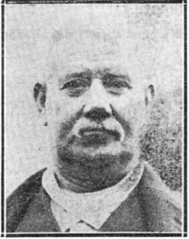
MR A. W. SANKEY
Mr. Sankey has retired with a clean record, a prized possession to all railwaymen. There was never an accident involving loss of life or serious damage while he was in the box and he was never late in going on duty. The only accidents he remembers at the Junction involved horses. A farm horse pulling a waggon was killed at Buildwas level crossing by a passenger, train, and a collision with a train caused the death of three more horses which were grazing near the station and had been brought there by a timber faller.
Neither on the Severn Valley line nor the branch lines to Wellington and Craven Arras (through Much Wenlock) has there been much alteration of passenger time tables in Mr. Sankey's time, but about thirty years ago, steam motor trains were run on the branch lines for about two years, at more frequent intervals, but were abandoned because their pulling power for heavy loads was not sufficient on the uphill gradients.
Goods traffic has greatly increased since the Buildwas power station was built, Mr. Sankey states. There are now three trains a day bringing in pulverised coal and slack, and six more goods trains, with coal and slack waggons. Mr. Sankey will spend his retirement in a cottage overlooking the junction.
18th February 1938
BROSELEY'S DEMAND
Broseley ratepayers have put forward a vigorous demand for a senior school of their own as opposed to a larger senior school at Much Wenlock, to serve Broseley as well as other places. The latter is the one suggested by the education authorities. At the Broseley meeting a ballot was taken and 97 votes were registered in favour of a separate school for Broseley, while there were no supporters for the Wenlock scheme. The Rector, the Rev. C. S. Jackson, was the principal speaker, and he produced some strong arguments against Broseley children being sent to Much Wenlock. He made a good case that could be applied with equal force to any proposal to build a senior school for a scattered and largely rural area. There are advantages in the Hadow scheme when the children live within easy reach of the school, but these largely disappear when senior schools are built in such situations that they can only be filled by transporting children long distances from their homes at the public expense. To this general argument against grouping may be added the special one that Broseley has a sufficient number of senior children to justify separate arrangements.
BROSELEY WANTS ITS OWN SCHOOL
RECTOR SAYS " MAKE A FIGHT OF IT"
Ballot Figures
97 to Nil
Against Joining With Wenlock
A meeting convened at the Town Hall, Broseley, on Sunday
afternoon to discuss the County Education Authority's proposal to erect a
senior school at Wenlock, to be attended by Broseley children, showed the
opinion of the town to be unanimously against the scheme. The Rector of
Broseley, the Rev. C. S. Jackson (chairman of the managers of the existing
In favour of an entirely new school for Broseley… 97.
In favour of the Local Education Authority's scheme …Nil.
The Rev. C. S. Jackson gave a resume of the Hadow re-organisation scheme, and said that it provided for new senior schools, with children, grouped in two or three streams, according to their intelligence and it was because of this that the proposal to have a senior school at Wenlock had come about. If Broseley children were taken to Wenlock, then the new school might be a three stream, and would certainly be a two stream school. But if there was a school at Wenlock and a school at Broseley, they would have to be one stream schools. The disadvantages of a one stream school was that there were children of varying intelligence in the same class and the master had either to concentrate on the forward boys at the expense of the back, ward, or the backward at the expense of the forward
Primarily the question was one of expense, because it would be cheaper to build one bigger school than two smaller schools.
Partly because of expense and partly because of the tendency to have three stream schools, the County Education Committee had decided that there was to be a new senior school at Much Wenlock. They proposed that every child over eleven should be transported from Broseley to Wenlock and they would be provided at Wenlock with a first-class dinner, price two pence. The children would leave Broseley at 8.15 and they would stay at Wenlock until 4.
RECTOR'S ARGUMENTS
He thought the chief objection to the proposal was that it would kill any community spirit they might have in Broseley. They were going to have a lot of children growing up in their midst without any spiritual home at all. Their school would be at Wenlock. Their home would be at Broseley. Any local patriotism, and he thought they had a fair amount of it in Broseley, was going to be killed. That might seem an assertion, but he thought there was a certain amount of evidence to prove that where children had been transported from their native villages, one got a lot of restless children without any real clinging to any particular place. There, were a certain number of troublesome children, perhaps lively children, he would not say wicked children, who behaved better by reason of the fact that they knew they might meet their teachers in the streets of Broseley, but if taken to Wenlock a great deal of restraint and proper discipline would finish and they would react against school discipline when they returned to Broseley. The school of the future was .not merely going to be a school that was open from nine till four, but the school was going to be very largely the home of the child. Their recreational facilities would be used in the evenings when school hours were over. This again might seem to be an assertion. He thought they would agree that the Victoria Institute, the Social Club, the Tennis Club and the Cricket Club, and other organisations in Broseley had done their best in circumstances which had not been altogether too easy. In the future these various forms of recreation would be State aided and State managed. These new schools would carry on all that kind of-work, formerly done voluntarily. If a new school was built at Wenlock, the Broseley children would not go back at night, and would be debarred from evening activities.
BROSELEY BECOMING INSIGNIFICANT?
The taking of half the teaching profession out of Broseley would make a difference to the town, and the fact that 170 children were having lunches at Wenlock each day would also affect them.
They were losing much in Broseley, because they sat still and did nothing. They saw one thing going after another, and if they were not careful, Broseley would sink into an insignificant place altogether. It was a wrong thing to raise false hopes. He felt whatever they did that afternoon would not have very much effect. He thought they should not take it sitting down, but should show themselves willing to make a fight of it.
WHY NOT BROSELEY?
Let them show the old spirit of Broseley, which did produce the goods and had done things in the past, and say quite openly and frankly "We have been sat on long enough. We are going to make our voice heard." He could see the children on a winter's morning, hanging about until the bus came, others arriving two minutes late and missing school for the day.
The County Education Committee wanted the Broseley school managers to say that the school at Broseley was not fit for children over eleven, and that it was too crowded, and therefore another school must be provided. They proposed to put a beautiful school in eleven acres at Wenlock. It was going to be a beautiful place, something similar to the school at Madeley, which they all thought was splendid. They said the managers must convert the present school into a primary school for children under eleven. That would make big demands upon the managers. He thought the managers would say "We have done our best. We have kept education going in Broseley for a great number of years. We cannot find any more money. You must take the school and turn it into a primary school." The Education Authority would probably spend £2,000 on bringing the school up to their standard for a junior school. If they could do that, they could, by spending more money build a senior school. What he was out for was an entirely new school for Broseley. If Wenlock could have an entirely new school so could Broseley. (Hear, hear.) With the Birch Meadow playing field, now belonging to the town, and the cricket field close by, a new school could be built at Broseley without there being any need to acquire eleven acres. They had the acres and they had the playing fields at Broseley. He did not think it would cost any more to build a new school, than it would be to convert the present one.
THE CHURCH'S VIEW
Some twenty questions were put to the Rector at the close of his speech. He said the cost of all school building was borne by the county rate. The proposed two penny dinners, he understood, would be wonderful value for the money. To the question "Have the Education Authority already decided to build this school at Wenlock, to accommodate Broseley children?" the Rector replied, No. What they have done at Wenlock is to buy ground, and plans are being prepared to build the school without accommodating Broseley children, I am told. I am told that all Broseley is doing now is to delay the whole proceeding and they will go on building the Wenlock school and leave room for extension, so that when Broseley people come to their knees and say " Take us in," they will be able to extend that school.
Mr. T. Broadhurst (a manager) agreed that this was so.
Mr. Jackson explained that the Education Authority's plan in the first place was to build a new school at Arlescott (midway between Broseley and Wenlock). The managers would not acquiesce in this plan, which would involve Broseley children cycling two and a half miles to the top of a hill, and Wenlock children making a similar journey, leaving a great building in the country empty at night. The promise was made that there should be two schools, one at Wenlock and one at Broseley. Then it was all altered and he was told the new school would be at Wenlock. The managers got in touch with the Education Authority. They argued and persuaded and did their utmost to get a new school built in Broseley.
25th February 1938
The River Severn Broadcast
Recording at Iron-Bridge
In connection with the broadcast of "River Severn," the B.B.C.'s feature from the main Regional programme on Wednesday and Thursday next week, three recordings were made at the Tontine Hotel, Iron-Bridge, on February 15, when the speakers recorded were Mr. Jackson, curator of Uruconium; Mr. F. R. Jones (Iron-Bridge), and Mr. H. S. Southern (Broseley). The recordings will be used in the forthcoming broadcast. Mr. Jackson dealt with the Roman remains. Mr. F. R. Jones described the former Iron-Bridge barge traffic and the position of Iron-Bridge to-day. It will be his first broadcast. He is a native of Iron-Bridge and has been post-master for the past 14 years. Mr. Southern spoke of the centuries-old Broseley tobacco pipe trade as the sole remaining manufacturer. Mr. Southern claims to be the first person in Broseley to broadcast, when he spoke in "The Microphone at Large" programme from Much Wenlock. Now he is the first person in Broseley to make a recording.
BROSELEY
CONSERVATIVE ASSOCIATION. —The annual meeting of the
Broseley Men's branch of the Conservative Association, together with a smoking
concert, was held at the Lion Hotel on Friday. The Mayor of Wenlock (Councillor
E. H. H. Shorting) presided, and was supported by Mr. W. M. Ridgewell (agent). Officers were elected as follows:
President, Mr. Hugh Welsh; vice-presidents, Dr. J. G. Boon, Alderman J.
Nicklin, and Mr. A. J. Kelley; chairman, the Mayor of Wenlock ; vice-chairman,
Mr. J. G. Broadhurst; treasurer, Mr. W. S. Instone; secretary, Mr. W. R. Pountney;
magazine secretary, Mr. Renwick. Messrs. A. Edwards, S. Bagley, and J. Richings
were added to the committee. The secretary reported an increase of 14 members
to a total of 50. Songs were given by Mr. H. Hurdley, Mr. .G. Jones (comedian),
Mr. M. Nicklin, and Mr. P. Reeves. The meeting was addressed by Mr. A. C. Gray
(
BROTHERHOOD. — There was an attendance of about one hundred
at a mixed meeting, on Sunday, when an address on . "The
SOCIAL. — About 110 people were present at a church social, run by the Social Committee, at the Town Hall, on Saturday. The first part of the programme was spent in games, and the second part in dancing. Refreshments were served by Mrs. C. Davis, Mrs. W. Davis, Miss White, Mrs. H, Watkins and Mrs. R. Smith. Mr. C. Davis and Mr. J. Jones were doorkeepers. It has been decided to continue the socials during Lent as "pleasant Saturday evenings," run on more subdued, lines.
CHOIR SERVICES. — Choir services were held at the
DEATH OF MR. W. J. JACKSON. —The death occurred on Sunday of
Mr. William John Jackson, aged 60, of Coneybury, Broseley. He was a native of
DEATH OF MR. J.
SEABURY. The death occurred on Monday of Mr. James William Seabury, 16,
WHIST DRIVE. — At the whist drive yesterday afternoon for the Town Hall Curtains Fund the winners were: 1 Mrs. Renwick, 2 Mrs. White, 3 Miss Horton. Mrs. E. H. Taylor and Miss Lister were hostesses, Miss Lister being M.C. and Mrs. Taylor presenting the prizes.
Beer Sold After Hours
IRON-BRIDGE CASE
Bench Consider Good Record of Licensee
At Much Wenlock Police Court on Monday Leonard Thomas Burton (40), licensed victualler, Station Hotel, Iron-Bridge, was summoned for supplying beer during non-permitted hours, at 10.15 p.m. on Saturday, January 29.
Edward Meredith, haulier, 20, Ladywood, Jackfield, was summoned for aiding and abetting.
Mr. A. N. Gwynne (
P.C. Blackburn said at 10.15 p.m. he walked into the bar of
the Station Hotel, and saw
In reply to Mr. Gwynne, witness said from six to ten customers were leaving as he entered.
Mr. Gwynne submitted that there was no case to answer, quoting a case in which a steward of a club was caught by the police bringing beer from the direction of the cellars, which he admitted was for a member. In this case it was held that there was no supply. Mr. Gwynne contended that in this case there had been no supply.
Superintendent Ridgeway submitted that the cases were not parallel, as in this case the customer was actually putting money over the counter, and was in the act of receiving the beer.
After a retirement the magistrates over-ruled Mr. Gynne's submission. Mr. Gwynne and Mr. Phillips then intimated that the clients would plead "Guilty."
Meredith said he arrived at 9.15. He had two pints of beer, and at 9.50 he asked for a pint of beer in a bottle. He stopped watching a game of billiards until after ten.
Mr. Gwynne said it would be a pity if a conviction was
recorded against
Mr. Phillips said that it was usual in these cases to have corroborative evidence. The prosecution was able to proceed by the fact that defendants admitted what had happened. It would have been easy for the landlord to have said, "This is my bottle. The two shilling piece was mine," and the prosecution would not have been able to proceed. His client ordered beer at 9.50 and forgot about it until he put his coat on. Then he went to fetch his beer, and the landlord reminded him that he had not paid for it. It was a technical offence. It was a thing that happened all over the country. The Borough of Wenlock had a wonderful record during the last two years without trouble with licensees. He believed the police were hoping that it would be kept up for three years, and he asked the magistrates to keep the record clean.
Superintendent Ridgeway said he did not dispute what had
been said as to the record of
After a retirement the magistrates dismissed the cases on
payment of costs. The Mayor of Wenlock (Councillor E. H. H. Shorting said they
took a lenient view because of
ROAD CASES
John Gittens, motor driver, The Bungalow, Broseley was summoned for permitting smoke which could have been prevented to issue from the exhaust of a motor cycle at Bridgnorth Road, Broseley, at 4.15 p.m. on January 23.
P.C. Blackburn said the road was blocked with smoke. Gittens said he had had a plug oiled up.
Superintendent Ridgeway said he did not press the case He had brought it as a warning
Gittens was ordered to pay the costs.
Kenneth Robert Purdy, builder's representative, 117,
The case was proved by P.C.'s Best and Evans, who followed Purdy in the police car.
4th March 1938
Women Beard Broseley Council
JACKFIELD PROTEST
Against Move to Broseley .
The tenants of two houses in Jackfield, whom the Broseley Council proposed to move to Broseley, under their re-housing scheme, sent their wives to the meeting of the Council on Wednesday afternoon to plead their case for remaining in Jackfield. The result was that the Council decided to make a further search for a housing site in Jackfield.
The two ladies, Mrs. J. Dodd and Mrs. G. Pritchard, presented a petition signed by the residents of Jackfield in support of their case. The petition stated "We the undersigned request, in view of the hardships entailed thereby; the decision to enforce residents of Jackfield to reside in Broseley, should be sympathetically" reconsidered. Mr. J. Dodd is employed at Madeley, and would have further to travel to work. Mr. G. Pritchard is a cripple and by living at Broseley he would be forced to give up his employment. We suggest the following alternative sites, both sides of the road, between `The Mount’ and ‘The Rock;’ Calcutts old brickworks; Calcutts school garden; Tuckies field."
Alderman A. Exley: that is all undermined.
The Clerk (Mr. F. W. Derry) said the petition covered three and a half sheets of foolscap.
The chairman: The whole inhabitants are taking up the case. He said that the Council had looked round Jackfield most carefully, but could not find a suitable place, except in one instance, and the price required for that was prohibitive. It was true that someone else had since bought it and built on it, but that could not be held up as a reason why the Council had not done their best. With regard to the general complaint of living in Broseley, there were two large works in Jackfield and some other works as well. The bulk of the People Working there lived at Broseley or Madeley.
HARDSHIP
Mrs. Dodd said her husband fought in the war, and if moved to Broseley he would be compelled to travel eight miles a day to reach and return from his work. He had no car.
Mrs. Dodd said that Mr. Pritchard lost, a leg in the war. Would the Council desire him to go from Broseley to Gitchfield for his day's work? They, had not been fair.
The chairman: You must not say that. We have only one thing to consider, and that is to fulfil our obligations to the Government. They send down to us and say certain houses are unfit for habitation. Certain houses were over-crowded. They told the Council to remedy it. The Council did not know who lived in the houses.
Mrs. Dodd: You have not been fair in trying to get ground in Jackfield.
The chairman: You must not say that. We know our business.
Mrs. Dodd asked why in the case of the piece of ground which the Council turned down because the price was too high, the Council did not take the owner to arbitration.
The chairman: We know all about that. That is not your business.
Mrs. Dodd stated that an individual family had been brought from Broseley to Jackfield and had a house built for them by the Council.
The chairman said in this case the land was given by the landlord, and he could not give them any more.
"You get on better if you are a nuisance," said Mrs. Dodd.
Mrs. Pritchard said she was appealing to the Council because her husband had lost a leg in the war, and would have great difficulty in getting to his work if moved to Broseley. She looked on the chairman as a gentleman and was sure he would do his-best for them. Councillor T. W. Howells: After those flattering remarks to yourself, I think we might make another effort to find a site.
Mrs. Dodd: We are wrapped up heart and soul in Jackfield. We have our school and church to look to. We have always been good churchgoers
It was resolved to visit Jackfield again and look for a site.
The chairman: Iwant you to understand that we have been round twice already. We have trod every yard, but we will go again.
BIRCH MEADOW PLAYING FIELD
Lengthy consideration was given to a report by a sub-committee, consisting of Councillors P. W. Parr, W. E. Davis and C. R. Jones and the Surveyor (Mr. F. Richards) on the Birch Meadow Playing Field and the possibility of using the Birch Meadow Chapel for the combined purpose of a pavilion and a physical fitness centre.
The Broseley Society for the Prosecution of Felons had offered to contribute £100 to the purchase price of the chapel, but it was decided not to purchase the chapel.
The report, which was unanimous, stated that the cost of repairing the chapel would be considerable, and sealed estimates had been obtained. They considered that the expense of the upkeep of the building, if converted for a keep-fit centre, would be too great to justify its being borne by the rates. They had no knowledge of any sum of money which could be obtained to convert this building. They were of the opinion that it was too far away from the playing field to be used as a pavilion.
The chairman said that the last sentence appeared to settle the question as to whether it was advisable to use the chapel in conjunction with the playing field That being the case he did not think they were any longer interested.
The estimates were then opened and were as follows:— Building work £58, painting and decorating work, etc., £48 10s. The building work included the removal of pews and of the gallery. These repairs were stated to be such as would put the building into good condition.
IMPROVEMENT PROPOSALS
The chairman said the Council had no intention of making the building a keep-fit centre only. If it could have been used for both purposes, there was no reason why it should not be so used. The sub-committee then presented their report, which contained the following suggestions for its improvement :-(1.) Improve the present football area, particularly by filling in depressions with soil. Plenty of suitable soil could be obtained from the new building site close at hand. Rolling and cutting and levelling would make of it an even patch of ground which could be used for winter and summer games. (2) A sandpit for children. (3) A putting course. (4) Seats in suitable places. (5) A shelter or pavilion, with sanitary arrangements. (6) Attention should be given to the timber on the Cockshutt Mound. (7). A running track round the football area.
The chairman said the Council had full responsibility to consider what sort of a shelter was necessary, and then try and get suitable estimates.
Councillor E. D. Collins advocated the purchase of a contractor's hut.
The Mayor of Wenlock (Councillor E. H. H. Shorting) said he strongly supported the report of the sub-committee. If the Prosecution of Felons Society liked to make their grant for the purpose of improving the field, it would be a useful thing.
Councillor Collins moving and the Mayor seconding, it was resolved to adopt the report.
The chairman said that was all the Council could do in the matter at present. They would have to have a special committee to go into it in a businesslike way.
SCAVEIVGING TENDER
The rate collector (Mr. A. G. Fenn) reported that he had collected the sum of £235 1s. on the water rate, leaving the sum of £110 3s. outstanding.
It was resolved that the tenants of the existing slum clearance houses should have their attention drawn to complaints of rubbish being thrown into adjoining fields.
The Clerk (Mr. F. W. Derry) said if they did not cease the practice they would have to have notice that their tenancies would be terminated.
The tender for scavenging from Mr. E. Edwards was accepted for three years, at £110 per year, with 11s. a day for day work.
PROPOSED CLEARANCE ORDERS
BROSELEY INQUIRY
Objections by
Owners
A public enquiry into eight clearance orders in the Broseley
ward, submitted by the Wenlock Borough Council for confirmation by the Ministry
of Health, was held at the
The Council's case was put by the Town Clerk (Mr. F. W. Derry) and there were also present the Mayor (Councillor E. H. H. Shorting),. Alderman J. Nicklin (chairman of the Broseley Ward Council), and most of the councillors for the ward.
The Town Clerk summarised the defects of the properties and when, at the close, the Inspector said he would view them and report to the Ministry, the Town Clerk said that the condition of the properties needed no advocacy from him. The properties themselves would speak louder and more eloquently than any words of his as to their need of demolition. If these houses did not come within the scope of the Act, then he knew of no houses in the borough which did.
The Town Clerk stated that the inquiry concerned eight
clearance orders. The orders were made by the Council in dealing with
unsatisfactory and unfit houses, under the five years' slum clearance
programme. They formed the second instalment, and were in addition to a number
of houses dealt with individually. The first instalment related to the making
of 16 clearance orders in the Madeley ward. The Council proposed to re-house
the displaced tenants on the
CONVERSION PROPOSED
Mr. J. T. Madeley, 40,
The defects were outlined by the Sanitary Inspector (Mr. C. J. Thomas), who said that each cottage had one living room, one bedroom and a cellar. The walls were out of plumb. The front wall was leaning seven inches in an approximate height of ten feet. The walls were leaning at the rear of the buildings, and these conditions indicated that the foundations wore defective. Both houses were extremely damp throughout. There was no damp proof course. There was no through ventilation and neither had a back door. Number 28 was ventilated by means of a side door in the wash-house, but it was not strictly through ventilation. Both houses were extremely damp, due to the porous brickwork and rising damp, through there being no damp course. Water supply was from the nearest hydrant, which was 65 yards away.
The Sanitary Inspector agreed with the owner that the roof and ceilings were in good condition.
The Medical Officer (Dr. M. Gepp) said that the houses were manifestly of a great age, and were built either at the end of the seventeenth or the beginning of the eighteenth centuries.
The owner said he would like to convert the two houses into one. He was a practical bricklayer and he believed he could put the premises in a condition satisfactory to the Council.
In reply to the Town Clerk, he said he had no plans or estimate. He could not do anything until the tenants left.
OTHER SUGGESTIONS
In the case of 11, 12, and 13, Back Alley, Broseley, Mr. R. J. Clarke (Wellington) was allowed to address the Inspector on behalf of the owner, in spite of the fact that notice of objection had not been given.
Mr. Clarke said no objection was raised to the demolition of No. 13. In regard to Nos. 11 and 12, it was contended that they could be made habitable at a cost of £25 for which a builder's estimate had been obtained.
The Medical Officer: I should be extremely doubtful as to that. I should say £25 would not put a decent face on them.
In the case of Nos. 59, 60, and 61, Lloyd's Head, Jackfield,
Mr. J. Price, appearing for his sister-in-law, Kiss Jones, of Newquay,
The Town Clerk said, if the Council saw fit at a later stage, they could apply to the Ministry to give them a grant for the purpose of re-housing the tenants, and ask that the structure should remain, provided it was not used as a dwelling. There was a case in the Madeley ward where premises used by a scrap dealer had been allowed to stand.
Other properties on which formal evidence of unfitness was
submitted to the Inspector were 6, 7, 8, and 9,
Broseley Preparing Manifesto
In Favour of 1
is Own Senior School
Further reference to Broseley's demand for a new school as an alternative to a combined senior school at Much Wenlock, as proposed by the County Education Committee, was made by the Rev. C. S. Jackson (Rector) at the annual social of Broseley Brotherhood, on Monday. The Rector said that the meeting held in Broseley in support of a school there had made an impression, and they wanted to make a still bigger impression. They wanted to get the signatures of all people in Broseley, demanding a new school there.
To obtain these signatures it was intended to divide
Broseley into districts, each with someone responsible for obtaining them. He
asked that those willing to do this work should give their names to Mr. J.
Goodall, the Brotherhood secretary. They were going to send to the County
Education Office at
The Rector presided at the social, others present being the Mayor of Wenlock (Councillor E. H. H. Shorting), Mr. and Mrs. H. Welsh (Willey), Mr. A. J. Kelley and Mr. J. R. Nicklin.
Refreshments were served, and about 100 people listened to
an enjoyable variety programme. It included selections by the Bridgnorth
Grammar School Orchestra, under the direction of Mr. Murton Smith ; selections
by the Broseley Handbell Ringers, leader Mr. A. Garbett sketches and songs by
Mr. H. Woodhouse's Concert Party (
18th March 1938
Iron-Bridge Police Headquarters
A new police headquarters for the Iron-Bridge sub-division, comprising the Borough of Wenlock, will be opened on or about March 25, when the police will transfer from the present Police Station in Waterloo Street, Iron-Bridge, to the residence known as "Eastfield," in Buildwas road, Iron-Bridge.
"Eastfield," which is close to the important Dale
End road junction of the Wellington and Shrewsbury roads, has been acquired and
converted by the 'Salop County Council, while, the old building belongs to the
Wenlock Corporation. It is important that the public should bear in mind that
the
On March 25 P.C. D. Brooks will be transferred front
Iron-Bridge to Market Drayton, and P.C. J. Evason will be transferred from
Market Drayton to Iron-Bridge, while P.C. A. Nichol removes from
" Eastfield " is a spacious house, standing in extensive grounds.
Sewerage of Iron-Bridge and Jackfield
Wrekin Member’s Question
Colonel Baldwin Webb has for several months past been interesting himself in the housing position at Iron-Bridge and Jackfield, and has been approached on the matter from many quarters in that district. It is felt that the population is slowly being withdrawn front these districts owing to lack of adequate housing facilities, with results damaging to the district. The difficulty is the lack of a sewerage system, and. the Member for Wrekin recently put down the following question for answer by the Minister of Health :
"With reference to the possibility of sewering the district of Iron-Bridge and Jackfield, whether the local authority have consulted an outside expert as well as the Ministry ; when they did so and with what result ; and what progress is being made with a view to the sewering of the area?",
Sir Kingsley Wood in his reply said :
"So far as I am aware, the local authority have not consulted an outside expert. A scheme for sewering this area has been considered from time to time but the local authority have not seen their way to proceed with it owing to the heavy cost involved."
BENTHALL
WRIST DRIVE. There were 12 tables at a whist drive in aid of
Posenhall Rovers F.C. at
DEATH OF MR. J. G. ONIONS. —The death occurred on Saturday
of Mr. James George Onions, Barrett's Hill Farm, Benthall, aged 42. Mr. Onions
is survived by his wife, two daughters and his mother, aged 81. The funeral
took place on Wednesday at
JACKFIELD
TABLEAUX. — St. Mary's Hall was crowded for a Lenten service and tableaux on Wednesday. An address was given by the rector (the Rev. F. J. R. Mason). The church choir were directed by Mr. W. Ellis and Mr. G. Edge was the pianist. . The stage manager was Mr. J. Cross and helpers behind the scenes, Mr. C. Hughes, Mrs.
Mason and Miss Cox. Tableaux were impersonated by the following children: Isaiah, King Ahaz and Shear-Jashub, Denis Pillinger, Clarence Groves and Master G. Edge; Joseph and Gabriel Hector Williams and Claris Hadley; The Virgin and Angel, Nancy Phillips and Claris Hadley; Magi, Norman Pritchard, Peter Jones and Joan Edwards; Shepherds, Fred Gallier, Ivy Weal and Jack Hatton; Angels, Veronica Gough, Gwen Hadley, Eileen Groves, Maureen Pillinger, Gordon Hatton, Phyllis Smith and Iris Jones; The Holy Family, Hector Williams, Nancy Williams, Mary Dodd ; presentation, Joan Bright and Clarence Groves; the Carpenter's Shop, Alan Yorke, Frances Galher, Mary Dodd and Enid Hadley; In the Temple, Clarence Groves, Norman Pritchard, Jack Hatton, Denis Pillinger and Sheila. The Final Tableaux represented a typical village war memorial in the form of a realistic stone cross, set in rural surroundings. Before the memorial busily arranging flowers were: A Mother, a Girl Guide, a Boy Scout and two small children, posed by Miss Ivy Cox, Ivy Weale, Hector Williams, Jean Evans, Maureen Pillinger.
25th March 1938
Broseley's Cowboy Singer
Some Experiences of R, Johnson
If there is one sure way of getting known to the public in a very short time, it is to stand up and sing, if you have the voice and courage to do so. Hence by putting in an unequalled amount of time as a singer at smoking concerts and other local functions, Mr. Robert Johnson, who has lived in Broseley only a few months, has become widely known in Broseley, Bridgnorth, Madeley and Dawley for his unique repertoire of American songs. In these districts, which pride themselves on their, musical ability, Mr. Johnson has won appreciation for his rendering, with his guitar, of the many airs that go back to the pioneer days of the American prairies, raided and copied so many times for dance and film numbers and roughly known as the "hill-billies.”
A "Chronicle" reporter asked Mr. Johnson how he came to learn them. He replied that his knowledge came from actual experience of the ranches. He said the cowboys of to-day are still as musical as they were in the wild western days depicted on the screen. They play the violin, the guitar, the banjo and the mouth organ, and while the six-shooter is no longer carried, the old songs are still sung. Singing is one of the few recreations on the ranches, but it also has a useful purpose, for believe it or not, some cowboys will sing their cattle to sleep. Rounded up in a valley, they will begin to lie down when such songs as "Home, sweet home, on the prairie," are sung from the hillside above.
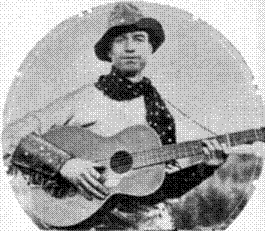 Mr
R. Johnson, “The Singing Cowboy,” who is a familiar figure at Broseley district
concerts.
Mr
R. Johnson, “The Singing Cowboy,” who is a familiar figure at Broseley district
concerts.
ADVENTUROUS CAREER
Mr. Johnson was-born in
A NEW YORK ADVENTURE Leaving the Navy, he found his way to
One day during a rather husky singsong; the manager came in wanting to know who was the star turn. He asked Mr. Johnson if he had done any public entertaining. He replied that he had not, but he was willing.
"All right, limee," said the manager (all
Englishmen. were called limees in the States). "I will give you a chance
in the club." From that day on he began making money. He was paid 15
dollars a night and an occasional 20 for an encore. Later he drove a motor
lorry and was wounded in an attack by gangsters. When he recovered he "jumped"
a train to
Then he drifted to the ranches and got a job helping the
cook. He was on about four different ranches and learned to play the guitar and
sing the cowboy songs, as only the cowboys can. He became a proper
"hill-billy." He came back to
2nd April 1938
BENTHALL ( Broseley )
MOTHERS'
JACKFIELD
COALFORD METHODIST CHURCH.—The anniversary was celebrated on Sunday with special services of a musical character. Hymns were sung by the choir, conducted by Mr. A. Skitt (organist and choirmaster), and there were two soloists. Miss E. Goodall and Mr. George Stewart. The preachers were the Rev. R. H. Osborne (Madeley Wood) in the afternoon, and Mr. H. Brown (Shifnal) in the evening.
OLD FOLKS ENTERTAINED.—The money raised by the Jackfield
carol singers was used to entertain the old folk of the parish at the Parish
Hall on Monday and about 50 old people received what has come to be regarded as
their annual supper and concert. The event this year was run on lines similar
to those of previous efforts. After an excellent supper a concert was staged
and Rev. F. J. R. Mason (rector), who had previously extended a welcome to the
gathering, announced the various items. Those taking part in the concert were
Miss K. Hudson (songs), Mr. A. Lewis (violin solos), Mr. R. Duce, Dawley
(songs), Mr. A. Perkins (songs), Messrs. N. Hudson and T. Green (step dance and
songs), Mr. L. Wallett (comedian), Mr. Boycott (accordion), Mr. Gauton (songs),
Mr. Sauvain, Dawley (original recitations) and Mr. G. Cleobury (songs). The
accompanists were Mr. Gerald Edge and Miss Ethel Perkins. Selections were also
given by the Iron-bridge Fellowship Harmonica Band comprising Messrs. J. Clay
(leader), Fred Jones, D. and W. Wall,
BROSELEY
A GIFT of new hymn books was made to the choir men of the Parish Church prior to the evening service on Sunday by Clive Southorn and Geoffrey Benbow on behalf of the young people of the parish as an expression of their appreciation of the fortnightly socials which had been held at the Town Hall throughout the winter in connection with the church.
PAROCHIAL CHURCH COUNCIL—The quarterly meeting was held at the Town Hall on Tuesday and after the formal business had been transacted the members were served with coffee by the ladies of the social committee; following which there was a discussion on church finance. The rector, the Rev. C. S. Jackson, presided.
THE HOUSE-TO-HOUSE COLLECTION in aid of the National Children's Home and Orphanage has resulted in the sum of £5 12s. being raised. The collectors were Mrs. F. Davis, Mrs. J. Harris, the Misses E. Davis, A. Evans, Jean Harris, May Ball, H. Morris, J. Heighway, Margaret Ball, M. Heighway and Messrs. Colin Jones and J. Sankey. The local secretary is Mrs. C. Thomas.
WHIST. — At the weekly whist drive held at the Town Hall on Thursday in connection with the ladies' renovation committee, the prize-winners were Mrs. A. Davies, Mrs. W. Andrews and Miss A. Harris. Mrs. Euridge was M.C. and the prizes were handed to the winners by Mrs. John Davies. The hostesses were Mrs Euridge and Mrs. J. Davies.
MOTHERING SUNDAY was observed at the
J. Clapton, Mrs. Seabury, Mrs. Darlington, Mrs. Hough and Mrs. A. Pountney. All the mothers wore bunches of violets provided for them by the rector.
JACKFIELD
LENTEN TABLEAUX. — The series of Lenten tableaux which have been held in the Parish Hall weekly have attracted considerable interest and have been noteworthy for the splendid posing of the children. — On Wednesday, when the fourth of the series was given, there was again a large attendance of parishioners. The subject of the rector's (the Rev. F. J. R. Mason) address was "'The Early Church." the story being illustrated by the tableaux. Those taking part were:— Mr. Leslie Roberts. Margery Bradley, Margery Dodd, Nancy Phillips, Alan Dodd, Clarence Groves, Hector Williams, Denis Pillinger, Norman Pritchard. Phyllis Hill, Ivy Weale, Joan Bright, Clarice Hadley, Fred Gather, Alan Yorke, Elsie Hadley and Ivy Cox.
THE WEDDING took place at the
METHODIST SOCIAL. — There was a fairly large attendance at the social held in the Coalford Methodist Schoolroom on Wednesday. Mr. J. Pumford presided, and together with Mr. J. Evans, organised a number of enjoyable games, which were interspersed with competitions, the winners being Mrs. Dodd, Mr. Evans and Master John Owen Refreshments were served by the following lady, teachers: - Mrs. J. Pumford, Mrs. Peake and Mrs. J. Evans.
9th April 1938
JACKFIELD
TABLEAUX REPEATED.—The seventy one tableaux which have been given at the Parish Hall on successive Wednesdays in Lent in illustration of talks on Old and New Testament history were repeated on Monday, Tuesday and Wednesday. The rector announced the title of each tableaux, which were given as a series of "still" pictures.
THE
BENTHALL (Broseley)
THE WEDDING took place at the
16th April 1938
JACKFIELD
DEATH OF MRS. M. A. HEARN
A well-known resident passed away on April 8 in the person
or Mrs. Martha Ann Hearn, Tudor Bungalow, The Knowle. Mrs. Hearne, who was the
wife of Mr. John Hearne, was 72. She was born at Madeley Wood and had lived in
Jackfield for about forty years. A regular attender at the
The funeral took place on Tuesday, a service at the
Wreaths were received from:—Husband; Jim and Ida; Will and Mary; Den and Ivy; Lol and Ethel; Bertha; Edna and Tom; Mrs. Prestage; Capt. and Mrs. Collins: Mr. and Mrs. W. E. Price and Bromwich; directors of the Prestage and Broseley Tileries Co.: employees at the Milburgh Works; Milburgh Pit; Wallace Works; Mr. Beddoes and Mr. Owen: Mrs. Kitson; Martha and family; Frank and Annie, Wilnecote: Mr. and Mrs.Cox; Ted and Pattie; Mothers' Union; Mr. and Mrs. Perkins and Winnie; Rector and Mrs. Mason; Mr. and Mrs. Joseph Dodd: Mr. and Mrs. H. G. Creed: Mr. A. Danks; Mr. and Mrs. H. P. Bowen; Mr. and Mrs. Lister, Mr. and Mrs. Aston: the Misses Smallwood; Mr. and Mrs. W. Anderson: Nellie and Herbert; Mr. and Mrs. W. H. Pearce; Edith and family: Mr. and Mrs. E. Poole: Mrs. Highway: Mrs. O'Connor: Mr. Morris and Ethel; Mr. and Mrs. Dicken: Mr. and Mrs. Danks and Mr. and Mrs. Smith; Mrs. Shinton. Bert and Annie; Mr. and Mrs. Edw. Hudson: Mr. and Mrs. Wm. Hudson and family: Mrs. Gilbert and boys; Mrs. Humphries and boys.
23rd April 1938
BARROW (Broseley)
THE WEDDING was solemnised at Barrow Church on Saturday of Miss Frances Minnie Lewis, eldest daughter of Mr. and Mrs. Arthur William Lewis, of 28, Barrow, and Mr. Thomas Henry Instone, only son of Mr. T. H. Instone, and the late Mrs. Instone, of 69, High Street, Broseley. The Rev. W. G. Beale (vicar) was the officiating clergyman, and Mr. W. Davies was at the organ, the service being choral. The bride, who was given away by her father, was attired in a pretty white satin dress cut on classical lines, with embroidered veil and coronet of orange blossom. She also wore white satin shoes to match, and carried a sheaf of arum lilies. Her necklet of lucky white heather was the gift of the bridegroom, who also presented necklets to the bridesmaids. Miss Irene Lewis and Miss Sally Lewis (sisters of the bride), and Miss June Williams (friend) were the bridesmaids. Miss Irene Lewis wore blue floral taffeta with wreath of blue forget-me-nots, white satin shoes, and carried a spray of white carnations. The other two bridesmaids were dressed in mauve taffeta, with silver shoes and headdresses, and carried Victorian posies. The best man was Mr. William Henry Lewis (brother of the bride). The reception was held in the schoolroom.
30th April 1938
 CHRISTENING
AT WILLEY –HEIR OF LORD FORESTER
CHRISTENING
AT WILLEY –HEIR OF LORD FORESTER
A Happy Snap taken after the christening. Lord and Lady Forester with their three children, Christine, Juliet and the baby George Cecil Brooke
THE picturesque
All the available seating accommodation was taken up and others who were able to gain admittance to the church, had to stand throughout the service.
The Bishop of Hereford (Dr. Lisle Carr) performed the ceremony, and he was assisted by the Rev. J. W. Isherwood (rural dean), the Rev. W. J. Beale (rector of Willey), the Rev. L. J. B. Snell (vicar of Holy Trinity, Hereford), and the Rev. A. C. Howell (rector of Little Wenlock).
The names chosen for the child were George Cecil Brooke.
The hymns sung during the service were "All things bright and beautiful" and "There's a Friend for little children," Mr. W. Wase being at the organ.
The Godparents were, Princess Alice (Countess of Athlone), the Hon. Mrs. Merry, of Belladrum, Viscount Newport, Viscount Maitland and Mr. H. Legge Bourke.
It was a great disappointment that the Dowager Lady Forester was unable to be present owing to her not having fully recovered from a serious illness.
Among
Those Present
Among those present at the church were, Lady Perrott (Lady Forester's mother), Viscountess Maitland, Lt. Col. the Hon. F. H. C Weld-Forester, Hon. Mrs. F. Weld-Forester, Hon. Mrs. Whitaker, Hon. Edgar Weld-Forester, Major the Hon. Edric Weld-Forester, Lady Victoria Weld-Forester, Miss Rosalind Weld-Forester, Miss Katherine Weld-Forester, Major Rowland Hunt, Mrs. Rowland Hunt, Mrs. Moore-Stevens, Mr. and Mrs. Hugh Welsh, Lady Tollemache, Hon. Mrs. Devereux, Col. J. Baldwin-Webb, Miss Webb, Mrs. Snell, General A. H. O. LLoyd, Miss LLoyd, Mrs. C. T. Dugdale, Mrs. Lisle Carr, Lord and Lady Acton, Sir Richard and Lady Leighton, Captain and Mrs. Villiers, Mr. Cartwright, Mrs. A. Howell, Mrs. Beale, Dr. F. H. and Mrs. Higley, Dr. J G. and Mrs. Boon, Captain Boon, Dr. F. Turner, Mr. R. Cooke, Mrs. Cooke, Mr. T. J. Mytton More and Lady Norah More, Mr. Beresford Ash, Lady Helena Beresford Ash, Captain G. C. and Mrs. Whitmore, Miss Wayne, Mrs. Isherwood, the Hon. Eustace Hamilton-Russell, Mrs. Hamilton-Russell, Miss F. Pitt, Mr. and Mrs. J. H. A. Whitley, Col. S. P. and Mrs. Keyworth, the Misses Keyworth, Captain and Mrs. Colville, Mr. and Mrs. Warlow, Major and Mrs. Thompson, Mrs. Crichton Browne, Captain Humphrey Lloyd, Mrs. Lloyd, Mrs. Prestage, Mrs. Shaw, General Harington, Lady Aline Harington, Miss Harington, General H. D. O. Ward and Mrs. Ward.
The Mayor (Mr. E. H. H. Shorting), Aldermen, Councillors and
officials of the Borough of Wenlock also attended, together with tenants and employees
on the Willey Estate and the bell lingers of
Reception
and Presentations
After the ceremony a reception was held at the Hall, where the health of the young heir was drunk. The toast was proposed by Mr. C. F. Wadlow (Posenhall Farm) on behalf of the tenants, and in doing so, he presented a silver casket as a memento from the tenants.
The Mayor supported the toast, and asked Lord Forester to accept on behalf of his son, the Georgian silver cup presented by the members and officials of the Wenlock Corporation. He offered to Lord and Lady Forester their most sincere congratulations on this happy event, and hoped the recipient of their little gift might have a long life of much happiness and usefulness. They hoped that he would make as good a soldier and sportsman as his father, and that in due course of years he would follow in his footsteps and in those of past members of his Lordship's family, in taking a leading part in the civic life of the Borough.
Mr. J. G. Broadhurst, on behalf of the indoor and outdoor staff, supported the toast

 and
wished the heir long life and happiness.
and
wished the heir long life and happiness.
Lord Forester, replying thanked everyone for their good
wishes and gifts, and said he hoped that some day his son would fill one of the
aldermanic chairs in the Guildhall at Wenlock. He also thanked the children of
When his son grew up, he hoped that he would be worthy of the love and affection that had been bestowed upon him that day.
List
of Presents
Presents were received as follows:—Four gold safety-pins in case, from the Dowager Lady Forester; 28 Savings Certificates. Lady Perrott; knife, fork and spoon in case, the Hon. Mrs. Merry of Belladrum; gold cuff-links, Viscount and Viscountess Maitland; silver cuff-links and shirt studs, Viscount Newport; Scriptural picture, the Hon and Rev. O. St. M. Forester; tie-pins, Sir Harold and Lady Boulton; silver egg-cup and poon, Major and Mrs. Rowland Hunt: silver bowl, Major and Mrs. Gatacre: gold tiepin, Mrs. Devereux, Bridget and Milo; gold tie-pin, J. Le Brun; antique spoon, the Rev. and Mrs. Beale; silver bowl and spoon, Mrs. Crichton Browne; 66 Savings Certificates, Miss Hare; antique silver rattle, Mrs. Charles T. Dugdale; Old Caughley mug, Mrs. Corfield; Edward VII. Coronation mug, Mrs. Kyte; napkin ring, Mrs. Alfred Howell; silver tankard, the Mayor (Mr. E. H. H. Shorting); cup and spoon, Col. J. Baldwin-Webb; silver spoon and pusher, Mr. and Mrs. Walter Jones; clothes, Miss J Leadbetter; Prayer Book, the Rev. and Mrs. L. J. B. Snell; present from Dr. Turner; gold charm, Mrs. Prestage; serviette ring, S. Finlay and S. Crisp: Bible, children of Barrow School; silver casket, tenants on the Willey Estate; silver cup, indoor and outdoor staff; silver goblet, Mayor and Corporation of the Borough of Wenlock.
IRON-BRIDGE
THE FUNERAL took place at Madeley churchyard on Saturday of
Mr. Frederick Ernest Turbill, 3, St. Luke's Road, a former railway employee,
and a well-known resident of Iron-Bridge. Mr. Turbill, who was 72, died on
April 19. He was born at Bromyard, Herefordshire. When he retired from railway
service at the age of 60, he had completed 47 years with the Great Western
Railway Co. At the time of his retirement he was Chief Goods Clerk at
Iron-Bridge, a position he had held for some years. He is survived by a widow,
son and daughter. A service was held at
FORMER BROSELEY DOCTOR MARRIED
A wedding of considerable interest took place at
Dr. Hoy who has recently taken up a practice at
The service was fully choral, and as the guests assembled in the church the organist, Mr. F. W. Fletcher, played the "Bridal Song" from the "Wedding Symphony" (Brautleid), "Traurnerei" (Schumann) and "Song of Melody" (David Clegg). On the arrival of the bride the organist played the "Bridal March" from "Lohengrin" (Wagner). The choir were in attendance and the hymns sung during the ceremony were "The Voice that breathed o'er Eden" and "O Perfect Love," while the 67th Psalm was chanted. The Rev. T. Eland (vicar) officiated.
The bride, who was given away by her brother-in-law, Mr. R. E. Piper, of Whitchurch, was attired in a dress of gold tissue with parchment tulle veil. Her pearl necklace was the gift of the bridegroom, and she carried a bouquet of lilies of the valley.
The bridesmaids were Miss Ena Ogle (sister of the bride), Miss Elizabeth Greenhalgh and Miss Jean Collins. They wore primrose silk net, over taffeta, with green velvet caps, sashes and shoes to tone, and carried bouquets of lemon irises. Their pearl necklaces were the gifts of the bridegroom.
Dr. S. W. Hoy (brother of the bridegroom) was best man, and the ushers were Capt. E. D. Collins and Mr. David Greenhalgh.
As the bride and bridegroom left the church to the strains of Mendelssohn's "Wedding March", they were greeted by a large crowd which had assembled outside the church.
The reception held at Severn Cottage was attended by upwards
of 60 guests, and later Dr. and Mrs. Hoy left by car for the
14 May 1938
JACKFIELD
OPEN AIR CONCERT.—The Jackfield Prize Silver Band, conducted
by Mr. W. Ellis (bandmaster), opened its season with a concert near the
COALFORD METHODIST CHURCH.— Continuation services of the Sunday school anniversary were held on Sunday, when the preacher was Mr. D. A. Pitchford of Dawley, who also presided over the afternoon musical service. Those contributing to the programme were Miss Edna Goodall, Joan Pumford, Alice Cleobury, Mary Edwards, Joan Wright, Molly Burgess, Netta Giles, Margaret Edwards, Ida Peake, Dot Hyde, Hazel Evans, Lilian Langford, Graham Dickens and Travis Dodd. Mr. G. Stewart conducted the choir, and Miss Owen was at the organ for the evening service. The total collections for Sunday school funds amounted to an increase on last year.
BROSELEY
LICENSEE'S DEATH. — Mr. Francis Kennedy, licensee of the
Pheasant Hotel, died on Saturday after a long illness at the age of 72. A
native of Dumfriesshire, Mr. Kennedy had spent some years abroad before coming
to Broseley, living in
HOMING.—The old birds' race from Frome on Saturday, organised by the Elephant and Castle Homing Society, in conjunction with the Worcester Federation, resulted as follows:—B. Colley 965, J. Jones 947, R. Jones 924, W. Jones 922, J. Higginson 921, A. Nock 914. G. F. Wall 878, R. Childs 866.
DEATH OF MR. G. GOUGH.— Alter a long illness the death
occurred on Monday of Mr. George Gough, aged 64, of 2,
THE FUNERAL of Mrs. Elizabeth Vickers, Orchard House, was
held at Madeley on Saturday, a service before the interment taking place in St.
Michael's Church, conducted by the Rev. H. Saxton (vicar). The chief mourners
were Mrs. M. E. Parkinson,
LATE MRS. E. MATTHEWS. — The funeral took place at the old
Baptist churchyard on Thursday of Mrs. Emma Matthews. 20,
21st May 1938
BROSELEY
THE FUNERAL of Mr. George Gough, Rough Lane, took place at
the cemetery on May 13, a service the at
the
A HOUSE-TO-HOUSE COLLECTION, organised by Mrs. R. Nicklin in aid of the British Empire Cancer Campaign, has realised the sum of £15 0s. 11d. The collectors were Mrs. W. Bowen, Mrs. A. Cross. Mrs. J. S. Griffin, Mrs. L D. Harris, Mrs. A. Jones, Miss E. Jones, Miss Edna Jones, Mrs. D. Molyneux, Mrs. R. Smith, Mrs. H. Seabury and Mrs. H .Watkins.
HOMING. — The race from Templecombe on Saturday, run by the Elephant and Castle Homing Society in conjunction with the Worcester Federation, was again won by B. Colley, with a velocity of 1,444 who also had the first three birds home. Other placings were:—G. F. Wall (1,387), A. Nock (1,372) J. Jones (1,371), R. Jones (1,343), W Jones (1 321) R. Childs (1,142) Higginson (732).
BROSELEY
CHILD'S DEATH. — Much sympathy has been extended to Mr. and Mrs. Harold Spurr, the Rectory, in the death on Sunday of their only child, David, aged 13 months. The funeral took place on Wednesday the Rev. C. S. Jackson (rector) officiating.
TENNIS CLUB.—The following officers have been elected for the year: President. Lord Forester; captain. Dr. S. W. Hoy; vice-captain and match secretary, Mr. D. Ridley; treasurer, Mr. R. Nicklin, Lloyds Bank; hon. secretary, Mr. W. E. Davis. Mr. Davis was also appointed to represent the club on the Shropshire Association to which the club has become affiliated.
BENTHALL (Broseley )
DEATH OF MISS E. M. DAVIS
The deepest sympathy of the district has been extended to
Mr. and Mrs. Frank Davis, Benthall Cottage, on the death of their only
daughter, Enid Mildred, at the age of 23. Miss Davis, who had been ill for a
few weeks, died at the
She was also a member of the choir, and was closely connected with the Methodist Crusaders' Club. She was actively associated with several out-door sports particularly tennis, and as a member of the Broseley Club, she was recognised as a player of considerable merit.
The funeral took place at the
The chief mourners were: — Mr. Frank Davis (father), Messrs. A. Wilde, Heyward Davis (Broseley), Charles Davis (Broseley), Arthur Davis (Coalbrookdale), Cecil Davis, Arch. Davis (Broseley), T. Instone (Craven Arms), and A. J. Cleobury, Broseley (uncles), Mrs. Wilcox, Iron-Bridge (aunt), Mr. M. Davis (cousin), Mr. E. Humphries (fiance), and Mr. and Mrs. Humphries.
The bearers were Messrs. C. Thomas, W. Batchelor, L. Morris, E. Harris, J. Harris, A. Evans, and J. Sankey (officers and teachers of the Sunday school).
Among others present were:—Mrs. H. Welsh (representing the Managers of Barrow School), Mr. G. B. Endacott (headmaster), Miss A. Johnson-Jones (teacher), and Betty Duddell, Rose Humphreys, and. J. Corfield, pupils (representing Coalbrookdale High School), Miss Mary Price (representing High School Old Girls' Association), Mrs. W. E. Davis (representing Broseley Tennis Club), Mr. C. R. Jones (Methodist Sunday school superintendent), and children of the Sunday school, Mr. A. O. Jones (society steward), Mr. and Mrs. W. S. Instone, Mr. A. G. Oswell, Mr. R. Gwynne, Mr. W. McLelland, Mr. W. Haynes, Mr. C. O. Jones, Mr. H. Oakley, Mr. J. Casey, Mr. W. Den-stone, Mr. G. Brown, Mrs. G. Thomas, Mrs. T. Hough, Mrs. Bowen, Mrs. W. Williams, Mrs. F. Williams, Mrs. M. Pugh, Mrs. Bagley, Mrs. Anthony, Mrs. Casey, Miss Meredith, Mrs. Bird, Mrs. Humphries, Mrs. Evans, Mrs. Rhodes, Mrs. Gallier and Mrs. Wase.
Wreaths were received from:-- Mummie and daddy; Grannie; Ernest; Auntie Olive and Uncle Tom; Auntie Nellie and Uncle Harry; Auntie Cis and Uncle George, Welshpool; Auntie and uncle, Worcester; Uncle Heyward, Auntie Laura and Matt; Uncle Charlie and family; Uncle Cecil and family; Uncle Arch and Auntie Elsie; Uncle Arthur and Auntie Annie; Uncle Arthur, Auntie May and Edith; Uncle Alan. Auntie Effie and Uncle George, Sussex; Auntie Annie and Uncle Jack Livingstone, Sussex; Win, Steve and John; Cis, Gladys and Lilian, Manchester; Lilian, Mavis, Sarita and Trevor; Auntie Nell, Wrekin View; cousin Nell and Elsie; Walter and Estelle Davis; Miss Freeman and Miss Webberly (Barrow); Rebecca (late of Broseley); Elsie and Edward Turner (Barrow); all at Bon Marche; Irene Clark; Mr. and Mrs. A. Aston, Mornwood; Enid Jackson; Mr. and Mrs. Instone and Mary; Mr and Mrs. C. Dyas,; Mr. and Mrs. Bert Jones; Vincent Aston; Joan, Margaret and Erenda Heighway; Mrs. Oswell and Mollie; the McLelland family; Mr. and Mrs. Humphries and family; Mr. and Mrs. C. R. Jones and Colin; Mr. and Mrs. C. O. Jones and Kathleen; all at Fox Lane House; John, Jeanette, Charlo and Betty; Mr. and Mrs. Rhodes; Mr. and Mrs. Gwynne; Mr. and Mrs. T. Davis,. Rob and Clare; Mrs. Terry Mrs. Howells; Mrs. Hill and family; Mr. and Mrs. Thomas, Doug and Cyril; Mr. and Mrs. Poole and Flo; Mr. and Mrs. Britton and family; Marjorie, Norman and family; Olga; Mr. and Mrs. T. Minton; Sissie and Cecil Thomas; Mr. and Mrs. Sands; Mr. and M. Molineux (Benthall); Mr. and Mrs. Casey and Googie; John and Jean Whitehead; all at 2, Barber Street; neighbours, Benthall Lane; cross and flowers from all the children at Barrow School; Coalbrookdale High School Old Girls' Association; teachers and scholars of Methodist Sunday school (infants); officers, teachers and scholars, Methodist Sunday school; Methodist Crusaders' Club; Broseley Methodist choir.
A memorial service will be held at
WENLOCK TOWN CLERK'S SALARY
£100 INCREASE
COUNCIL'S KEEN
DEBATE
THE recommendation of the Finance Committee of the Wenlock Borough Council that the salary of the Town Clerk (Mr. F. W. Derry) be increased by £100 per annum as from March 31, 1938, came up for confirmation at Wednesday's quarterly meeting of the Council.
The Mayor (Mr. E. H. H. Shorting) at the outset intimated that he had received a letter from Mr. Derry in which he stated that while he very much appreciated the spontaneous recommendation of the Finance Committee with regard to the increase in his salary and particularly the spirit which prompted it, he regretted after careful consideration he could not see his way to accept it if it was to be a charge on the housing revenue account as distinct from the general borough fund. He felt that though such a charge was legal and morally justified having regard to the work entailed by these schemes, it might cause some hardship to the Council house tenants, particularly following the increase of rent which they had already suffered.
The Mayor, as chairman of the Finance Committee, reported that the committee had considered Mr. Derry's intimation and recommended that the increase be charged on the general rate fund.
Opposition
Mr. C. Powell, moving an amendment that the increase be not granted at present, said he appreciated Mr. Derry's letter declining the increase if it was charged to the housing revenue account, because there was no doubt that their tenants particularly the old age pensioners, were crying out already over the recent increase in rents, and any further charge on that account would certainly have caused a hardship. Their ratepayers were mostly working class families with exceedingly small incomes they had to think in pence, not in pounds as some people did. In view of this he was pleased it was not being charged to the housing revenue account.
"Rates
Leaping Up"
Nevertheless, he still opposed the increase being made. Their rates were definitely going up, they were leaping up, and he was sorry to say that he could foresee the borough rates being 20s. in the £ the way they were going at the present time.
He would like to pay a compliment to the Town Clerk in recompense for the brick bats that it had been suggested had been thrown—they were not underestimating his value as Town Clerk or his ability but it was more than they as a poor borough could afford to pay.
Mr Powell then moved his amendment that the increase in salary be delayed until such time they could see their way clear to pay it.
Mr. S. Hotchkiss seconded.
would be a greater hardship still to them if their rates were increased.
Mr. O. D. Murphy, supporting the recommendation, said the last increase paid to the Town Clerk was in 1925. Since then the work had increased and he thought Mr. Derry earned every half-penny he got and more and more work was put upon Mr Derry, they must expect to pas for it. He felt that if Mr. Powell and those who supported the amendment looked at it from that point of view they would change their minds.
Ald. Barnet said they all appreciated Mr. Derry's good services, but he was quite sure in one way or another that he was well paid.
“Election
Propaganda"
Ald. Roberts described a reference by Mr. Hotchkiss to the assistant Town Clerk getting only £50 as "propaganda for coming elections.” He (Mr. Hotchkiss) knew perfectly well that the assistant Town Clerk was remunerated by Mr. Derry and no doubt he was properly paid. The proposed increase would mean a ¾d. rate. As Mayor's auditor for a considerable number of years and one in a position to know what was behind the scenes, he could testify to the increased work performed by the Town Clerk during the past few years, and he thought Mr. Derry was justly entitled to the increase in his salary.
Mr. Hotchkiss said he still adhered to his point that it was not right that the deputy Town Clerk should be on "our books at £50 per annum."
Mr. W. E. Davies pointed out that the Town Clerk had not asked for a rise, but from the facts which had been placed before the Finance Committee the latter had decided that a rise was due. He supported the committee's recommendation.
Mr. R. A. Jones also supported.
When the amendment was put to the meeting seven voted in favour, while thirteen supported the committee's recommendation, which was declared carried-
Mr. Derry, returning thanks, said he appreciated the increase, not for the actual amount, but for the spirit in which it had been offered and the circumstances under which they had given it.
Late
Ald. Nicklin
Before the business of the meeting, the Mayor made reference to the passing of Ald. Nicklin, whose death, he said, had left a vacancy in their midst which would not be easily filled. His life was an example of usefulness and high achievement, which many a younger man might do well to follow.
Ald. Roberts (Madeley Ward), Ald. T. H. Thompson (Wenlock Ward), Ald. W. Bishop (Barrow Ward), Ald. Collins (Broseley Ward)'. Mr. E. S. Owen and Mr. Derry (on behalf of the officials), added their tributes. The meeting stood in silence as a mark of respect.
Capt. E. D. Collins was elected an alderman in place of Mr. Nicklin.
New
Fire Station Scheme
The Town Clerk intimated that the Ministry had now sanctioned the purchase of the site at Iron-Bridge for the new fire station and as he understood the Government were giving certain fire appliances free, he thought it would be advisable if the fire brigade sub-committee applied early to the Government.
JACKFIELD
BAND CONCERT. — Conducted by Mr. Wm. Ellis (bandmaster), the
Jackfield Prize Silver Band gave their second promenade concert of the season
at the
GIRL GUIDES. — Betty Hadley arid Elsie Hadley, two members of the Jackfield Company of Girl Guides, have been chosen to take part in the Shropshire Guides' exhibition of hornpipe dancing at the forthcoming demonstration by Scouts and Girl Guides at POWIS Castle, Welshpool, Nancy Phillips and Vera Hadley have been appointed reserves.
BOAT INN BOWLING CLUB. —The annual Meeting took place at the Boat inn on Monday. The secretary (Mr. E. Hodge) presented the balance sheet, which had been audited by Mr. W. Storey, and it was revealed that the club had a balance in hand of 19s. 6d., which was considered very good. The following appointments were made:—Chairman, Mr. P. Preece secretary and treasurer, Mr. E. Hodge: captain, Mr. L. Stephen; vice-captain, Mr. IX Pritchard; committee, Messrs. W. Hatton, R. George, J. Hammond, H. Burton, A. Cleobury, L. Stephen and D. Pritchard.
28th May 1938
DISTRIBUTION OF GAS MASKS
The scheme for distributing gas masks in
Respirators are made in three sizes, and, in order to decide the numbers of each which will have to be kept at the various stores, it will be necessary to take a census of the population. This work is being undertaken by Air Raid Wardens, who are volunteers and have received a special course of training, and it will be necessary for them to visit every house in order to ascertain the size required by each occupant. In this matter of the census, Dawley is first in the field and is making a start on June 1. The Borough of Shrewsbury will be next, and other towns will follow suit in the near future. Similar measures will be taken in the country districts at a somewhat later date.
4th June 1938
BROSELEY
DISTRICT COUNCIL
At Broseley District Council meeting on Wednesday, Mr. T. W. Howells moved the appointment of Ald. A. A. Exley (vice-chairman) as chairman to succeed the late Ald. J. Nicklin. Ald. Exley, he said, had been a member of the Council for 29 years, and had had a great deal of experience.- Mr. E. H. H. Shorting seconded the motion, which was carried unanimously, and Ald. Exley returned thanks.
Mr. T. W. Howells was elected vice-chairman.
Mr. Shorting read a letter he had received from Major Rowland Hunt, complaining about the heavy rates, and saying that his rates appeared to have doubled in the last few years.—The town clerk explained that the rates had increased consequent upon the higher assessment to Major Hunt's property, due to extensions.
The surveyor in his report, stated that the estimated cost
of erecting 25 yards of fencing on the Jackfield side of the
He further stated that the estimated cost of repairing the
road and footpaths at the Council houses, near
Following complaints by a number of people in Broseley Wood,
mentioned by Mr. C. R. Jones, it was decided to erect a post in
The Ministry having sanctioned the new sewerage scheme, the Council were empowered to raise the money by loan over a period of 30 years.— It was reported that the contractors, Messrs. More's Quarries, Bishop's Castle, had informed the Council that they were prepared to employ 80 per cent. of local unskilled labour if available.
With regard to emergency fire brigade equipment for which the Borough Council had applied, the town clerk stated that the Home Office had informed him that until the Council formulated a scheme to deal with emergency fire organisation they were not prepared to consider the application for trailer pumps. The matter was referred to the fire brigade committee.
BROSELEY
COUNCIL VACANCY. — A vacancy having occurred on the Broseley
Council following the elevation to the aldermanic bench of Capt. E. D. Collins,
who succeeds Ald. J. Nicklin, polling will take place on June 16 for the
election of a new councillor. There is a possibility of a three-cornered fight
for the seat. Mr. C. T. Harrison, plumber and house decorator of Cape Street,
Broseley, and Mr. Thomas Fletcher, retired railwayman, of 57, Crews Park,
Broseley Wood, have announced their intention of standing. Mr. Harrison, who is
a member of the local Conservative Association and chairman of the British Legion,
is well-known in the town. Mr. Fletcher, who came to live in Broseley Wood
about 8 years ago from
PARTS OF SHROPSHIRE TO HAVE ‘BLACK OUT’
COUNCILS AGREE TO CO-OPERATE
ALL IN AFFECTED AREA ASKED TO ASSIST IN A.R.P. TEST
THERE is to be a "black out" in parts of
This announcement was made at the monthly meeting of Oakengates Urban Council on the Wednesday, following the receipt of a letter from Major Golden, A.R.P. County Controller, in which he stated that on the dates mentioned the Chief Constable of Wolverhampton was organising a "black out" in connection with which A.R.P. and local authorities were asked to co-operate within a radius of 15 miles of Wolverhampton.
It was stated by Major Golden that the
Major Golden intimated that the suggestion was that street lighting in the places affected should be turned out, that as far as possible no house lighting should show outside, and that cars should run on side-lights only within the area.
Major Golden added that it would be of assistance to the very limited traffic there would be at that time in the night if the kerbs at any bad turnings or road junctions in the Oakengates urban area were whitened.
It was realised, continued Major Golden, that in the Oakengates area there was a considerable number of collieries, works, etc., which, under peace conditions, could not dim their lights, and it was appreciated therefore that the "black out" at the best could only be a partial one.
Its main object however was to eliminate any visible lighting in the town.
The Council decided unanimously to co-operate in the matter, and the surveyor (Mr. Lee) was requested to communicate with the Gas Co. in regard to the switching off of street lighting.
The Chairman (Mr. H. Onions) expressed the hope that tradespeople and townspeople generally would co-operate in order that the "black-out" might be made as effective as possible.
Broseley
Council to Co-operate
Broseley District Council on Wednesday also considered the matter, and agreed to co-operate in the plan. Mr. F. Richards (surveyor) was asked to undertake the work of getting the corner kerbs painted, and the town clerk (Mr. F. W. Derry) said he would notify the general public either by posters or through the Press.
IRON-BRIDGE
DEATH OF MR T. I. GRIFFITHS
A well-known resident of the district, Mr. Thomas Instone Griffiths, died at his home, Bridge House, on May 27 at the age of 80. He had been ill for a short while. A son of the late Mr. Thomas Griffiths, timber merchant, of Coalport, and brother of Mr. Will Griffiths, the well-known former county cricketer, of Coalport, he was a director of the firm of Prestage and Broseley Tileries Co., Ltd., which he joined in 1882, serving as secretary to the Company for many years before being appointed on the directorate.
Of a kindly and cheerful disposition, he led a busy life and was as active as ever up to the last. A sportsman in every sense of the word, he was best known perhaps for the great interest he took in hunting. For nearly 70 years he had been a foot follower of the Wheatland Hunt. He was particularly fond of walking, and he covered many thousands of miles while following his favourite sport. A keen participator in all outdoor sports, he played football in his younger days for Shifnal and Madeley, and cricket for Madeley and Willey Wanderers, among other clubs. He achieved a reputation as a wicket-keeper who never used the long stop. An experienced fisherman, he had many successes with the rod and line.
In 1906 he went to live at Broseley and became a member of
the Broseley Council for several years just before the Great War. He regularly
attended
A widow and son survive him.
The funeral took place on Monday at
The bearers were Messrs. W. Roden, G. Cadwallader, J. Roberts, H. Roberts and R. Taylor (employees of Prestage and Broseley Tileries Co.), and A. Williams (employee at Coalport timber yard).
Among those present were Mr. C. H. Moger,
Wreaths were received from the following:—Mrs. T. I. Griffiths; Tom and Gertie; Will and Emma; Annie and Sarah; Annie, Bill and Betty; Victor and Madge; Mr. and Mrs John Walford; Betty; Charles H. Moger; Mr. and Mrs. Collins; C. W. Potts; J. S. Barker; Mrs. Edward Owen; E. and M. Exley; Mrs. D. L. Prestage; Mr. and Mrs. T. J. Hearn; Mr. and Mrs. T. Instone; Mr. and Mrs. H. Roberts and Mary; Mr. and Mrs. J. R. Nicklin; Mrs. Allen; Enid Jackson; Mrs. Fletcher and Julia; Mrs. Alfred Bennett; Mr. and Mrs. Morris and family; Mr. and Mrs. Joseph Lloyd; Mr. and Mrs. J. A. Cole directors, Prestage and Broseley Tileries Co.; employees, Prestage and Broseley Tileries Co.; the workmen at Caughley Pit; committee and members, Broseley Social Club.
The funeral arrangements were carried out by Messrs. William Lloyd and Sons, Iron-Bridge.
11th June 1938
BROSELEY
RATEPAYERS' BRANCH FORMED.—At a meeting, arranged in connection with the Wenlock Ratepayers' Association, held at the Town Hall on June 3, it was unanimously decided to form a Broseley branch of the association, to incorporate Benthall and Barrow districts. Mr. E. L. Westell, who presided, said the association existed not to be a nuisance, but to encourage electors to take a greater interest in municipal affairs between elections, and to look after matters appertaining to their well-being outside the province of the Council. Mr. H. E. Graham Smith, outlining the aims of the association, said they must not overlook the fact that they governed themselves through the medium of elected representatives, but hitherto in that area the ratepayer had had no medium through which they could express their opinions on matters of general interest. Again there had been a "parish pump" attitude in the borough for many years. Each district had been inclined to be concerned only with its own interests, and there had been a certain amount of jealousy. The association was going to discourage that by the cultivation of a broader outlook. It was out to work for the good of everyone in the borough, and not any particular small section of the community. There were a great many people in the borough who were very poorly paid, and they had interests that should be watched. It was possible that many of these people, though poor in pocket, were by no means lacking in brains, and there should be a medium through which their ideas could be brought forward, discussed, and acted upon. The chief aims of the association were: —Economy in public expenditure; to encourage public interest in matters of public welfare; to encourage a constant study of municipal affairs; to form a channel for the collection of ideas for the reviving of the district; to provide adequacy of public service such as telephones, nursing, postal facilities, etc.; to work for Council meetings to be held in the evenings. Mr. C. Powell, Mr. K. Stead, Mr. Billington (Madeley), nd Mr. J. Maiden also spoke in support, then Mr. W. J. Ritchings proposed the formation of a branch at Broseley. The Rev. C. S. Jackson said if the association could do anything to cure the apathy of the district, it would be doing wonderful work. He felt the association should exercise its influence on the County Council too, in matters like education—Broseley was going to be very badly hit over this—and he was of the opinion that had they had more activity on the County Council, they would have had their bridge over the river by now. If the association had a broad-minded policy, he was confident that it would get a good deal of backing. He seconded the resolution for the formation of the branch.—Speaking on behalf of Jackfield, Mr. J. W. Harrison said it was unfair of the Council to take people away from their work to live at Broseley. They were told there were no sites in Jackfield, but he did not agree. He pointed out that they had no representative for Jackfield. He supported the formation of an association. The following were elected to form the committee for the Broseley branch: —Broseley. Rev. C. S. Jackson. Messrs. J. Maiden, T. Wedge, W. J. Ritchings, and Mrs. G. Potts; Jack-field, Messrs. J. W. Harrison. T. C. Gibbs, and J. Dodd; Benthall, Messrs. I. Roberts and W. Owen; Barrow. Mr G. Taylor.
JACKFIELD
BAND CONCERT.—The annual visit of Jackfield Prize Silver Band to The Rock, the residence of Mr. E. J. Exley, took place on Sunday. The band was conducted by Mr. William Ellis and the programme: included a cornet duet by Bandsmen A. Gittings and C. Hudson.
PARISH CHURCH.—There were early celebrations of Holy Communion on Whit. Sunday at 7 and 8 a.m., followed by Sung Eucharist at 11. The celebrant was the rector, the Rev. F. J. R. Mason who also preached. Mr. Gerald Edge was at the organ, and Mr. W. Ellis conducted the choir. The church had been decorated for the occasion by the lady members.
DANCE.—The Parish Hall was the chief centre of attraction on Whit Monday, when a dance was held in the evening, organised by the parish entertainment committee in aid of the Sunday School outing fund, and a company of over 100 spent a jolly evening. Mr. P. W. Parr was the M.C., and the lucky spot winners were Miss Phyllis Colley and Mr. E. Harrison, the prizes being presented by Mrs. C. S. Williams. Refreshments were served by the ladies' catering committee of the parish. The secretary for the event was Mr. Laurence Hearn, who was assisted by Mr. C. Hughes and Members of the committee.
DEATH OF MR. W. DAVIES.— The death occurred on Thursday of Mr, William Davies, who had been licensee of the Half Moon Inn for 35 Years. Aged 73, he was born Coalport, and for many years worked at Messrs. Craven Dunnill’s as a burner. In his younger days he was a good bowler and quoit player. A son and four daughters survive him. The funeral takes place to-day (Saturday).
25th June 1938
BROSELEY
THE FUNERAL of Mr. Henry Watson, 1, Barratts Hill, took
place on Saturday, the Rev C. S. Jackson (rector) officiating. The chief
mourners were Mrs. A. Watson (widow), Messrs. Bert and Jack Watson (brothers),
Mrs. W. Bacon, Dawlish (sister) ; Mrs. S. E. Law (mother-in-law), Mrs. J.
Watson and Mrs. E. Davies, Market Drayton (sisters-in-law), Messrs. H. Evans, -
Withington, and E. Davies (brothers-in-law), and Mr. Sam Norgroves, Callaughton
(cousin). Among others present were Messrs. W. Tudor, J. Fielding, F. Gough, E.
Lloyd, S. Jones, E. Carter, R. B. Weekes (secretary of Broseley Social Club, of
which Mr. Watson was a member),
BAND CONCERT.—The Jackfield Prize Silver Band, under the
conductorship of Mr. W. Ellis, gave a concert on Sunday evening, in the grounds
of
LATE MR. J. TAYLOR. — The funeral of Mr. John Taylor,
Hockley Bank, took place on Saturday, a service at the
BROSELEY
ALLOCATIONS.—At a meeting held at the schools on Thursday in connection with the recent Broseley schools' football competition for local charities it was announced that the receipts had amounted to £26 14s. 7d., and after payments of £10 19s. 1d. had been made, there was a balance of £15 15s. 6d. A sum of £3 10s. was kept by as a working balance, and the remainder was allocated as follows:—£1 1s. to the sports fund of each of the five competing schools, namely, Broseley. Much Wenlock, Madeley, Bridgnorth St. Mary's and Bridgnorth St. Leonard's; £1 to Bridgnorth Infirmary. £1 to Shirlett Sanatorium, £1 to the Royal Salop Infirmary, £1 to the Orthopaedic Hospital, £1 to Iron-Bridge Child Welfare, £1 to Dr. Barnardo's Home (Much Wenlock), 10s. to Broseley Comforts Fund Cupboard. It was stated that since the competition started in 1934, £97 12s. had been distributed to charity. The secretary for the competition was Mr. R. Brookes, the chairman Mr. P. W. Parr, and the treasurer Mr. J. R. Nicklin
SUNDAY SCHOOL ANNIVERSARY.—There were good congregations at
the
LATE MISS A. BUCK. — The funeral took place on Tuesday of
Miss Amelia Buck, 7,
9th July 1938
BROSELEY
LATE MRS. R. RAISWELL. The funeral of Mrs. Rosannah
Raiswell, 5, Maypole Road, took place at Sutton Maddock on July 1, the Rector
of Kemberton officiating. The chief mourners were Messrs. W. and E. Raiswell
(sons), Mrs. J. Brown, Wrentnall (daughter), Mr. and Mrs. G. Harris,
HOUSING SCHEME AND LOCAL LABOUR
The decision of the Broseley Council to erect a post in
She said she came to protest on behalf of her husband who
was put to great inconvenience by the closing of the road, where he had his
garage. They had used it for many years, and she could not see that it was a
danger, especially as so few people used it. She admitted that the garage could
be approached from the
Replying to Mrs. Simmonds, Mr. C. R. Jones said he had
receives complaints about traffic using the road from people in
Mrs. Simmonds said that people in both
In a letter written to the council Mrs. Simmonds stated that she had lived in the same house since childhood, and the road had been used for a motor-vehicle for the past 15-years.
Mr. W. E. Davis said it was not a road used by ordinary traffic, and he did not think they should take away a privilege that had been there for many years. The road was very narrow, but that added to the safety, for the traffic using it could only crawl along.
Mr. Jones maintained it was dangerous, and, if it were opened to traffic again, that there would be a fatal accident there.
On the proposition of Mr. T. W. Howells, seconded by Mr. Jones, it was decided to defer the matter to the next meeting, and in the meantime members of the council would visit the spot.
With regard to the work just commenced on the council's new housing scheme. Mr. P. W. Parr asked whether Iron-Bridge men were getting preference over Broseley men in obtaining employment. He knew Broseley men were employed there, but why were men sent from Iron-Bridge when there were still Broseley men available? He said he knew of men being on a site at 7 o'clock in the morning, and the contractor had sent down for men to the Iron-Bridge Exchange.—Mr. A. J. Penberthy (architect) said that the contract specified that preference should be given to local labour. That was the first time he had heard about it; he did not know where the men came from. He suggested that the town clerk should write to the contractors. — Mr. Davies said he could not understand why men should be sent from Iron-Bridge when there were Broseley men signing on there.— It was decided to write to the manager of the Iron-Bridge Employment Exchange as well as to the contractor.
Following the acceptance of a tender for £2 10s. from Mr. Instone :for the crop of grass on the Birch Meadow playing field, Mr. Howells said he did not think they were exercising any control over the playing field. He thought it would be as well if the committee which had been appointed to deal with the matter previously now developed their ideas on the lines which had been suggested. He was told that children had been prevented from playing cricket owing to the long mowing grass. He contended that there should be some organised Management of the field, and suggested that the committee should draft a scheme.
Mr. Parr reported that, owing to a leaking hydrant, which
necessitated the tap being turned off, the residents of
The council agreed to pay Mr. H. Ball £26 and Mr. Roberts £3 8s. as compensation for use of field and gardens for the council's housing site.
A letter of complaint having been received front Miss Lister regarding paper blowing about in High Street and suggesting that a paper container be fixed to the lamp by the Town Hall, the council decided to purchase six containers for various parts of the town.
At the outset of the meeting the chairman (Ald. A. A. Exley) welcomed Mr. T. Fletcher, the new member of the council.
16th July 1938
IRON-BRIDGE
PETTY SESSIONS
Tuesday, before the Mayor (Mr E. H. H. Shorting), Major-Gen H. D. O. Ward, Ald W. Roberts and W Bishop and Messrs J. S Barker and C. W. Edwards.
A
Tale Of A Bike
How a 17 years-old Broseley boy rode a motor cycle, stated to have been sold for 15s., without it being licensed or insured, and what he did when he saw a policeman in the distance, was described when the rider, Maurice Austin, a milk roundsman, of 25, Workhouse Road, Broseley, was charged with a number of offences in connection with the machine. He pleaded "Guilty" to committing the following offences:- Using the motor-cycle without a policy of insurance in force: without a current driving license: without a Road Fund license; without two independent brakes and without having identification plates thereon.
George Perks (18). of 15, Hockley Road, Broseley, labourer, was charged with permitting Austin to ride it when it was not covered by a policy of insurance; aiding and abetting him to drive without a driving license; aiding and abetting him to drive without a Road Fund license; and, being the transferee of the motor-cycle, failing to enter his name and address in the registration book and deliver it to the County Council.
James Edward Jones, 19,
All the defendants pleaded "Guilty."
P.C. Ogilvie said that at about 12-30 on June 12 he was near
Mr. L. Rushworth, who prosecuted on behalf of the Salop County Council in respect of the failure to notify the licensing authority, also gave evidence and stated that Perks, had sent the registration book in on June 22 and the machine had now been scrapped.
Jones said it was. quite an Innocent mistake on his part.
After a retirement the chairman announced that
JACKFIELD
POLICE CONSTABLE WEDS
Local police constables, accompanied by Inspector J. H.
Machin, formed an archway with their truncheons for the wedding at the
The service was conducted by the Rev. F. J. R. Mason (rector) and was choral, Miss Ethel Perkins being at the organ. The altar was prettily decorated with flowers, the gift of Mrs. Williams (the bride's grandmother). Given away by her father, the bride wore a dress of ivory satin with a corsage of orange blossom, a headdress of silk net and a coronet of orange blossom. She also wore satin court shoes and carried a bouquet of white roses and maidenhair fern. The bouquet and the gold wristlet watch she wore were the gifts of the bridegroom. Miss Madge Williams (sister of the bride), the only bridesmaid, wore silk lace over silk taffeta in the new shade of green, with a velvet sash to match. Her headdress was a green lace cap with bows of green tulle and two buttercup-yellow roses. She also wore gloves and shoes to match her dress and a gold signet ring (the gift of the bridegroom). Her bouquet, which was also presented by the bridegroom, was of buttercup-yellow roses and maidenhair fern. The best man was Mr. Edward Boardman (brother of the bridegroom), and Mr. Malcolm Williams (bride's brother) was usher.
On leaving the church the bride was presented with a silver horseshoe by her niece, Miss Angela Williams.
A reception was held at the bride's home, and later the happy couple left for Rhyl, the bride travelling in a dress of mustard silk crepe with a hat to match and a swagger coat.
BROSELEY
12-YEARS-OLD
BOY
"AN AWFUL NUISANCE"
"This record of yours is very bad. You are evidently a
mischievous young monkey," said Mr. C. H. Parker (who was accompanied on
the Bench by Mr. E. J. Exley) at
Alice Gertrude Oakes, Firs Farm,
P.C. Ogilvie said he interviewed defendant, who told him that he had taken the chicken when he was with two more lads and had put it in a field by a gate. Having ascertained that defendant was seen to throw something into a nearby garden, witness saw him again. The boy then told him that he had thrown his handkerchief into the garden. Witness had not been able to find it or the chicken. The garden had probably been swept up.
Inspector J. H. Machin said it seemed that the boy had put the chicken in his handkerchief and killed it. He probably threw it away in his handkerchief. The inspector added that the boy had been an awful nuisance for two or three years now. He had been cautioned times out of number. They thought the time had arrived to bring him before the court. He was a regular little bully.
The boy's mother said her son had had meningitis and had had seven operations. "He is killing me with worry and yet I stick to him." she said after the magistrates had announced their decision.
Describing it as his last chance. the magistrates bound the boy over for two years in the sum of £5. and placed him under the care of the probation officer, Mr. E. G. March. The parents were ordered to pay 15s. costs.
JACKFIELD
DEATH OF MRS. A. PRITCHARD. --A well-known resident passed
away on Sunday, after an illness lasting 16 months, in Mrs. Ann Pritchard, 38.
Lloyd's Head. Mrs. Pritchard died at the home of her daughter, Mrs. E. Hadley,
23rd July 1938
WENLOCK TOWN COUNCIL
Mental
Hospital
Ald. J. H. Whitley, in presenting the report of the visitors to the Salop Mental Hospital, said that the Board of Control proposed to spend a sum of £70,000 on the institution during the next three years, and Wenlock's contribution would he as follows: 1939-40, £1,171; 1940-41, £1,952: 1941-42, £2,243.
The Mayor said it was a heavy expense but the loans would. be spread over a period of 30 years.
The question of the appointment of an officer to carry out duties imposed on local authorities by the Factory Act, 1937, was referred to the Finance Committee,
The Council adopted notices of motion for the demolition of
89 to 95 (inclusive)
Medical
Officer's Report
The annual report of
the medical officer of health was presented to the meeting by Dr. M. Gepp. It
stated that the birth rate per thousand of the population was 18.3, which was a
very satisfactory figure compared with 14.9 for
The sanitary inspector (Mr. C. J. Thomas), the report stated, had followed up very actively the facilities for improved drainage and house sanitation afforded by the completion of the new sewerage schemes in the Madeley ward, and had by advice, assistance and supervision, secured a marked advance in sanitation and amenity.
With regard to housing, very good progress continued to be made towards the improvement of housing conditions. In an area in which so much of the cottage property was of old construction, the raising of the standard of housing was therefore a matter that would require much care and some time. The Council's five-year programme with regard to slum clearance, which would end this year, dealt with 163 houses. The number of persons re-housed and to be re-housed was 573. In the Broseley ward plans were passed during the year for the erection of 50 houses at Broseley, and in the Wenlock ward plans for 24 houses were passed.
The Mayor commented that it was a very satisfactory report and reflected credit on Dr. Gepp and Mr. Thomas.
At the outset of the meeting, the Mayor extended a welcome to Mr. T. Fletcher a now member.
JACKFIELD
THE WEDDING took place at the Parish Church on Saturday of Miss Edna Goodall, youngest daughter of the late Mr. and Mrs. James Goodall, 58, Lloyds Head, Jackfield, and Mr. Cecil Garbett, youngest son of Mrs. and the late Mr. Thomas Garbett, 23, Mill Lane, Broseley. The Rev. F. J. R. Mason (rector), officiated. The bride, who was given away by her brother, Mr. J. Goodall, wore a dress of blue silk marocain, with a hat to tone, and lizard skin shoes. She carried a bouquet of white carnations. Attending her were Miss Florence Edwards (her niece), and Mrs. Elsie Hyde, in navy blue costumes, with hats to match, and lizard skin shoes. They carried white handbags, the gifts of the bridegroom. The best man was Mr. Wilfred Garbett (brother of the bridegroom). A reception was held at the bride's home. Among the presents was a canteen of cutlery from the bride's workmates at Messrs. Maw and Co., Jackfield.
A RUMMAGE SALE was held in Coalford Methodist Schoolroom on Saturday, when the proceeds, amounting to £8, were devoted to Sunday School funds. The helpers at the stalls were Mrs. J. Pumford, Mrs. W. H. Poole, Mrs. E. Peake. Mrs. J. Evans, Mr. Pumford and Mr. Evans.
WHIST.—At the weekly drive at the Parish Hall on July 15, the prize-winners were:-1 Mrs. A. Wilson, 2 Mrs. Sykes; 1 Mr. H. Maiden, 2 Mrs. Preece, Coalport (playing as gent.); travelling prizes, Mrs. Barber (Coalport), and Mrs. Comes. Mrs. E, Green was M.C., and the prizes were presented by Mrs. Poole.
30th July 1938
BENTHALL (Broseley )
FETE AT BENTHALL HALL
The beautiful grounds of Benthall Hall were the setting or
Wednesday of the church fete organised by a committee representing
The Mayor (Mr. E. H. H. Shorting) presided at the opening
ceremony, supported by
Mrs. Heywood declared the fete open and a bouquet was handed to her by little Doreen Owen.
The stalls and helpers were:— Produce, Mrs. Gregory, Mrs. Jakeways, Mrs. Gething, Mrs. Arch. Davies, Mrs. Robinson and Mrs. Rowe; antiques, Mrs. Benthall; books and stationery, Mrs. George Jones, Mrs. E. Davies (Much Wenlock) and Miss Dora Rowe; ice-cream, Mrs. Cooper and Mrs. G. Jones; sweets, Mrs. G. Thomas, Mrs. H. Owen, Mrs. A. Owen and Miss McDermott; pound stall, Mrs. J. Cross and Mrs. Sandland; fancy work, Mrs. Terry and Mrs. Foster; flowers and plants, Mrs. George Potts and Miss H. Potts; Broseley Mission Sewing stall, Mrs. E. C. S. White, Mrs. Corfield, Miss Horton and Miss Grocott; buffet, Mrs. Minton, Mrs. E. Burd, Mrs. A. Burd, Mrs. Marsh and Mrs. E. Humphries; teas, Mrs. A. Wilde, Mrs. C. Dyas, Mrs. Aston, Mrs. Barber, Mrs. Herriman, Mrs. Taylor, the Misses Muriel Marsh, Frances Cross, Mary Onions and Betty Plant; flower sellers, Ella Gregory, Cylvia Arrowsmith and Maisie Brazier; hoop-la, Mrs. G. Whitmore, Frank Cooper and Graham Whitmore; balloon bursting, Mr. C. Watkins and Mr. J. Hall; darts, Mr. H. Watkins and Mr. J. R. Fowler; horse-racing, Mr. A. Cartwright; ladder-golf, Mr. E. Rowe; demon speedway, Frank Arrow-smith; gate-keepers, Mr. W. Owen and W. Whitmore. The cake competition in the charge of Mrs. F. Jones and Mrs. Brazier was judged by the Mayor of Bridgnorth. The winners were;-1 Mrs. Jakeways, 2 Mrs. R. Taylor, 3 Miss A. Evans.
Folk-dancing displays and singing games were given by the
infants of
The arrangements for the fete were made by a joint committee, of which the vicar was chairman and Mrs. Gregory (Benthall) secretary.
BROSELEY
ORGANIST MARRIED. — Mr. Ronald A. Yorke, youngest son of
Mrs. Yorke and the late Mr. J. A Yorke, 19, High Street, Madeley, was married
on Saturday at
SOCIAL. — About 20 members of the women's section of the Broseley branch of the British Legion attended the monthly social which was held at the Rectory on Monday. A programme of games and competitions had been arranged and the winners of the latter were Mrs. J. Clapton and Mrs. Molyneux. Mrs. Chadwick, who is staying at the Rectory, gave a songs being accompanied by Mrs. T. H. Bickley. The hostesses for the evening were Mrs. Clapton, Mrs. Ward, Mrs. Ritchings and Mrs. Sneyd. Mrs. G. Whitmore expressed thanks to the Rev. C. S. Jackson for allowing them the use of the Rectory and grounds for the social.
PETTY SESSIONS
Tuesday. before the Mayor (Mr. E. H. H. Shorting), Major Gen. H. D. O. Ward. Ald. W. Roberts and Mr. J. S. Barker.
Passed
Halt Sign
Fines of 5s. were inflicted on Albert Edward Harper, The Werps, Jackfield, bricklayer, and Arthur Penketh, 17, Delbury Road, Hall Green, Birmingham, for failing to conform to a "Halt" sign at Waterloo Street, Iron-bridge, on July 16 and 17 respectively.
P.C. Evason proved both offences.
Harper in a letter to the Bench, said he did not see the sign; he was looking at some men working, on the corner. He had been riding a bicycle for 30 years with a clean record.
Penketh, who told the constable that he did not see the "Halt" sign as he was looking at the hill in front of him and thinking he would have to go up there, was represented by Mr. Matthews, a solicitor of Wolverhampton, who entered a plea of "Guilty."
6th August 1938
BROSELEY
CAMPING
POST TO REMAIN
The erection of the post in
At last month's meeting of the District Council, Mrs. Simmonds made a request for the removal of the post, on the grounds that the road was not dangerous and that the erection of the post caused inconvenience.
At Wednesday's meeting of the council, over which Ald. A. A.
Exley presided, the Town Clerk (Mr. F. W. Derry) read a letter from Mr. E.
Kempshall, of 41,
Previously, Mr. Nock, Broseley Wood, had appeared before the Council to state that he hoped the post would remain, as the road was dangerous if used by traffic.
The Town Clerk also read a letter from Messrs. Gwynne (solicitors) stating that they had been consulted by Mr. Simmonds concerning the closure of Sycamore Road to traffic and asking for the removal of the post
Mr. T. W. Howells said he had visited the Toad with the chairman and he thought there was no doubt that the post should remain. He considered that it would be dangerous to allow cars there.
Mr. T. Fletcher said only about three cars a week went down there and there had not been any accidents. He thought the post should be allowed to stay.
Mr. C. R. Jones, the Mayor (Mr. E. H. H. Shorting) and the Chairman expressed the view that the post should remain, and the council decided on this course.
A letter was read from the County Council stating that the special sub-committee appointed to consider applications from local authorities for grants in respect of sewerage work schemes would be meeting in due course, and the town clerk would be notified of the decision made—Mr. Derry said that the inspector at the public inquiry, and also the Ministry since, had mentioned the desirability of a grant being made by the County Council in respect of their sewerage scheme.
The Water Engineer (Mr. A. O. Callear) said he would like it to be more widely known that there was a special charge for using water on gardens with hose pipes or tubes. The charge was £1 a year and such users should notify him.
13th August 1938
MUCH WENLOCK
Transfers
The following transfers were granted:- Half Mood, Jackfield from executors of William Davies to Mrs. Lily Barnes; Vaults, Iron-Bridge, from Robert Bourne, to William Albert Knight; Albion, Broseley, from William Baden Well to Ronald G. Murphy; Fox, Much Wenlock, from Charles Ernest K. Parry, to Henry Powell; Plaza Cinema license, Coalbrookdale, from Alan Edward Steward, to Randle Wolverson.
JACKFIELD
LATE T.
BROSELEY
LATE MR. J. R. PERKS. — The death occurred at the Royal
Salop Infirmary on Saturday following a long illness, of Mr. John Richard Perks
of 79,
BOYS' BAND FORMED. — The recently formed schoolboys' band, started by Mr. C. Tonkiss and continued under the conductorship of Mr. A. W. Williams, has been taken up enthusiastically by the boys. A recent practice so impressed a visitor connected with West Bromwich carnival that he straightway engaged them to take part in the event next month. The first public engagement of the band was at Coalport on Wednesday, when the boys played at a concert held in the Coffee Room. The members of the band are — Jim Meadows (accordian), Ronald Williams (banjo), Guy Tonkiss (drums). Tom Meadows (saxophone), and G. Heighway (clappers).
CARNIVAL TO BE REVIVED.—At a representative meeting held at
the Victoria Institute on Monday, presided over by Mr. P. W. Parr, it was
decided to revive the carnival at Broseley towards the end of September and to
combine with it pony racing and children's sports. The meeting had been called
by Mr. A. W. Williams, and the decision to hold the three events was moved by
Mr. R. Picken and seconded by Mr. F. W. Whitehead. Mr. J. R. Nicklin was
appointed treasurer, and the following committees were elected— for pony racing
events, Messrs. F. Oakley, Dromgole,
LOCAL PREACHERS' FELLOWSHIP. --- A well-attended meeting was
held at the
20th August 1939
COALFORD
METHODIST CHURCH
RE-OPENING
IMPRESSIVE DEDICATION SERVICES
SUNDAY was a memorable day in the history of Coalford Methodist, Church, Jackfield, Broseley which was re-opened following extensive decorations.
The proceedings commenced with a large procession, when formed
up at the
"Open The Door
Of This House”
Following this service the minister knocked, on the doors of the church, saying meanwhile to the steward (Mr. R. Colley), who stood within: "Open the door of this house that we may go in to declare the works of the Lord". The doors were then opened and the large congregation filed into the church.
The service inside was of a most impressive character, for it registered the re-consecration of the church after decoration, the dedication of the new heating apparatus and of the new hymn-books which were being used for the first time, and the dedication of the mural tablet in memory of the late Miss E. Scott, through whose munificence much of the work was made possible.
The service was conducted by the Rev. Osborne, who gave an appropriate address, pointing out that it was not sufficient that they should re-dedicate the church or dedicate the other items concerned, but that they should, in addition to all these things, rededicate themselves to the work of the church and to the service of God. Jackfield Band, playing from the vestry, led the singing of the first and last hymns and during, the collection played Beethoven's "Minuet in C".
Memorial Tablet
Unveiled
The mural tablet was unveiled; by Mr. C. R. Jones, of Benthall a trustee, who read the inscription on the tablet, which was as follows:—To the Glory of God and in memory of Miss E. Scott, through whose munificence the heating apparatus was made possible. The memory: of the just is blessed".
An Overflow Service
The members coming together from Madeley Wood, Broseley and Jackfield and elsewhere were of such numbers that an overflow service was held in the school room. This service was conducted by the Rev. E. W. A. Barber, M. A., of Madeley, who was assisted by the officers of the Sunday School.
Before the service in church was concluded the overflow from the school crowded into the church join in the singing of the last hymn.
Following the pronouncing of the Benediction the large congregation then filed out into the open and, again led by the band, sang the National Anthem.
Mention should also be made of the donors of the beautiful Bible, hymn-book and organist's tune-book, each of which had been handsomely inscribed by Mr. Ball, of Jackfield.
Rev. Osborne's Farewell.
In the evening the congregation was again good, and the service was conducted by the Rev. Osborne.
This was followed by the Sacrament of the Lord's Supper, and at the close Mr. Osborne said it was with much regret he had to say that that was the last service he would be conducting at Jackfield, prior to leaving the district.
Mr. T. Wright, on behalf of the church expressed their very warm appreciation of the services of Mr. Osborne during his four years in their midst.
IRON-BRIDGE
THE WEDDING took place at the Parish Church on Sunday of
Miss Ethel May Hurdley, eldest daughter of Mr. and Mrs. A. E. Hurdley, of 7,
New Bridge Road, Iron-Bridge, and Mr. William John Thomas, third son of Mrs. J.
Beaman and the late Mr. Thomas, of 27, Barnetts Leasowe, Jackfield. The Rev. E.
Roberts (rector) officiated. The bride, who was given away by her father, wore
a dress of white figured marocain with wreath and veil and shoes to tone. She
carried a bouquet of red carnations. The bridesmaids attending her were Miss
Phyllis Sweet-more,
BROSELEY
OUTING.—Members of the choir of
ACCIDENT.—While cycling with two other Broseley boys along
the Bridgnorth Road on Tuesday afternoon) Herbert Bill, aged 14, of 20, Foundry
Lane, fell from his machine and sustained head injuries. He was taken home by
car and later removed to
PASTOR'S FAREWELL
The Rev. T. Lloyd Morgan, who has been pastor at the Baptist
churches of Broseley and Madeley for nearly nine years, and who is leaving to
take up duties at Oakham and Langham in
On Monday a farewell tea to the Rev. and Mrs. Morgan was
given by Mr. E. Correll (church secretary), and Miss Bennett, a member of the
church. Among those present were the Rev. R. H. Os borne (Madeley Wood Methodists),
Rev. C. E. Wright and Messrs. W. Williams and E. Glover (Congregational Church,
Broseley). Mr. C. R. Jones, and Mr. and Mrs. A. O. Jones (
Mr. H. Evans (Sunday school superintendent), spoke on behalf of the Sunday school scholars and then Evelyn Jones and Jean Whitehead, two of the scholars, handed over to Mr. Morgan a large framed photograph of the Sunday school. A bouquet was presented to Mrs. Morgan by Eileen and June Boden.
The second presentation to Mr. Morgan was a gift of money, subscribed by members of the church and friends, Mr. Correll made this presentation.
Mr. Morgan suitably replied,, thanking everyone for their kind gifts.
27th August 1938
JACKFIELD
THE WEDDING took place on Saturday at the
WHIST. — The prize-winners at the weekly whist drive held at the Parish Hall on Aug. 19' were:-1 Mrs. Barber (Coalport)) 2 Miss Cleobury ; 1 Mr. A. Rogers, 2 Mrs. Hurdley (Iron-Bridge) (playing as gentleman); consolation, Mrs. E. Williams: competition winner) Mrs. H. Evans. The M.C. was Mrs. E. Green and Mrs. Preece, Coalport, presented the prizes.
THE WEDDING was solemnised at the
BROSELEY
PRESENTATION. — The Rev. R. H. Osborne, of Madeley Wood, who
is retiring after being connected with the Madeley section of the Wellington
Methodist Circuit for the past four years, preached his farewell sermon at the
OUTING.— About 80 scholars of the
LOCAL BOYS' BAND. — The recently-farmed boys' band, under
the guidance of Mr. A. W. Williams, has accepted an invitation to play at a
variety concert at
A COLLISION occurred at the junction of
SOCIAL CLUB FLOWER SHOW
Entries were well up to average for tile annual flower show staged by the Social Group on Saturday and Sunday. Vegetables were a strong feature of the show, and there were particularly line exhibits of potatoes. The flowers provided a colourful display and were greatly admired.
The event was opened by Dr. J. G. Boon, chairman of the committee of the club, and a vote of thanks was accorded him by Mr. F. S. Francis, who also thanked the judges, Messrs. E. H. h. Shorting (Mayor), G. Potts and G. Thomas.
The Baldwin-Webb Cup for the most points gained was won for the second year in succession by Mr. A. Ogilvie with 23 points. The runner-up was Mr. C. Shaw (18 points).
The secretarial arrangements for the show were made by Mr. R. B. Weekes, assistance being given by members of the sports' committee. Mr. E. Francis was judges' steward.
On Sunday evening Jackfield Prize Silver Band gave a programme of music on the club lawn.
The prize-winners were:—
Vegetables and fruit—Round potatoes-1 R. Taylor, 2 J. Brown,
3 C. Roberts. Kidney potatoes-1 H. Harris, 2 J. Tisdale, 3 (equal) C. Shaw and
R. Taylor. Peas-1 A. Ogilvie, 2 T. Meredith, 3 J. Ritchings. Runner beans-1 A.
Ogilvie, 2 J. Ritchings, 3 T. Meredith. Parsnips-1 A. Ogilvie, 2 T. Goodall, 3
J. Evans. Carrots-1 H. Harris, 2 A. Ogilvie, 3 T. Goodall. Onions-1 A. Ogilvie,
2. T. Meredith, 3 C. Shaw. Eschalots-1
H. A. Wood, 2 L. Shaw, 3 A. Ogilvie. Beetroot- 1 A. Ogilvie, 2 T; Goodall. Cauliflower- 1. C. Shaw, 2 L. Shaw.
Green cabbage-1 A. Ogilvie, 2 T. Meredith Pickling cabbage-1 C. Shaw, 2 L Shaw.
Vegetable marrows-1 No award, 2 J. Tisdale. Dessert apple —1 A. Ogilvie, 2 H.
Harris, 3 A. Harris. Cooking apples-1 A. Ogilvie, 2 A. Harris, 3 G. Whitmore.
Tomatoes-1 L. Shaw, 2 T. Meredith, 3 (equal) F. Davies and card with no name.
Celery-1 L, Shaw, 2 C. Shaw, 3 A. Ogilvie. Flowers.-Collection of cut flowers,
four varieties-1 E. H. H. Shorting) 2 C. Shaw, 3 T. Meredith. Roses, four
distinct varieties-1 C. Shaw, 2 E. H. H. Shorting, 3 T. Meredith.
Buttonhole rose -1 T. Meredith. 2 R.
CARNIVAL.— A general meeting of the sports and carnival committee was held at the Victoria Institute on Wednesday when progress was made with regard to the arranging of events and fixing of prizes. It was announced that the proceedings would conclude with a grand torchlight procession. A "spot the window" competition was also arranged in connection with the event, which takes place on Sept. 17.
3rd September 1938
BROSELEY
LATE MISS R. INGRAM. — The funeral took place on Tuesday of
Miss Rose Ingram, 32,
SECOND ANNUAL FLOWER SHOW
Following on the success of the Old Broseley Flower Show, revived last year to commemorate the Coronation, the organisers this year extended the scope of the show. Another fine collection of flowers, fruit and vegetables was staged at the C. of E. Schools on Friday and Saturday, all the available space for this colourful take of the show's display being taken up. Competition was keen and the judges had no easy task in making their awards.
The outstanding feature of this year's event was the splendid exhibition arranged by the arts and Craft section. This proved a great attraction last year, but with increased support this year—there were over 500 entries—more classes were introduced, the standard of the work was even better, and the made up a display that reflected praise on the exhibitors.
Opening
Ceremony
Presiding at the opening, which was performed by Lady Acton, the or (Mr. E. H. H. Shorting), said it was a happy suggestion made last year to hold an annual flower show to commemorate the Coronation. It was not an easy thing to make a fresh beginning after a lapse of so many years, but thanks to the friendly spirit of co-operation, which was then so much in evidence, and perhaps more Particularly to the genial influence of one who had since passed from them (Ald. Nicklin), last year's show was an outstand success. He was glad to see they were making good progress. The number of entries in the horticultural classes had been well maintained, and in the opinion of the judges, many of the exhibits were of a very high standard. They were greatly indebted to the ladies for their staging of the arts and crafts section and they regretted that their president, Lord Forester, was away from Willey and was unable to attend. Lady Acton in declaring the show open said she was full of admiration for all she had seen. She commented that when ever thing to-day seemed to be turn, machinery—one article was so much like another—it was refreshing to be allowed to look at things which people had done their own hands, putting their own ideas and skill into operation and making the job a labour of love. She congratulated the organiser on the fine show and also the exhibitors.
A bouquet was presented to Lady Acton by Miss Linda Meredith, who made a little speech. The Rev. C. S. Jackson thanked Lady for opening the show and also the Mayor for presiding.
Standard
Well Maintained
Despite the poor season the standard of the exhibits in the horticultural classes reached a high level. The vegetables section was particularly good, some fine specimens of potatoes, carrots and peas being shown both in the cottages’ and open classes. The fruit was also a good show. The floral exhibits made and impressive display and perhaps the outstanding classes were those for cut flowers, A striking exhibit in the open class was the nine dahlias shown by Mr. A. H. Thorn-Pudsey for which he was awarded first prize. Mr C Clarke Bruff of Coalport, also has a fine collection of dahlias in the non-competitive section. Here also was a choice collection of fruit and vegetables entered by Lord Forester. There were close on 300 entries in the horticultural classes.
The arts and crafts department
separated into seven sections. The woodwork classes demonstrated the skill and
patience of the manual workers and probably the outstanding exhibit was that
submitted by Mr. J. Roberts of Delphside. It
was a Dutch electric reading and card
lamp carved with a knife from an old oak
pit prop which had been buried in a local mine since about 1750. A working
model of a beam engine entered by Mr. J. W. Griffiths, of Carver's Road, was
another exhibit to attract attention. Other articles on display included a skilfully-designed
model of the “Cutty Sark", a book-case, tables, seagrass stools, cabinets
and clothes-airers. The needlework, fancy work, knitting and miscellaneous
classes produced some remarkably fine handwork, particularly among the children,
although they did not take all the honours. A first prize in one class was
awarded to Mrs. Hope of High Street, who is 84 years of age, a distinction
which was also shared by Mrs Bright, who is over 70. One exhibit, which won a
third prize for Mrs Gwynne of Benthall, was a house coat which had been cut
from a gentleman’s coat worn at
3rd September 1938
JACKFIELD
OUTING.—On Saturday a party of about
170 left Jackfield for
WHIST.—At the weekly whist drive held at the Parish Hail on Aug. 26, the following won prizes: 1 Mrs. J. Goodall, 2 Mrs. Cox; Mrs. Hurdley, Iron-Bridge; 2 Mr. A. Rogers: consolation, Mrs. Rogers; competition winner. Mrs. Thomas, Coalport. The prizes were presented by Mrs. Wilson and Mrs. E. Green was M.C.
ALLOCATIONS.— At a meeting of the
Jackfield Hospital Committee at St. Mary's Hall on Monday and presided over by
Mr. Heyward Davies the treasurer. Mr. L. Hearn announced that the total
collections last year amounted to £10 1s. 8d. It was decided to make the
following allocations: — Eye, Ear and
JACKFIELD
OVER 60 YEARS WITH SAME FIRM
A member of one of the best-known families in Jackfield died on Saturday in the person of Mr, John Hearn, Tudor Bungalow, The Knowle.
Mr. Hearn, who was 74, was a son of the late Mr. William Hearn, Jackfield. He had been ill for the past three weeks. Starting work at the age of 8, when working and attending school alternately was permitted, he had had a life long connection with the Prestage and Broseley Tileries, where he had been employed as foreman for the past 38 years. When he retired in April, shortly after the death of his wife, he had completed over 60 years' service with the same firm.
He took an active interest in all
matters concerning the welfare of Jackfield and his presence will be especially
missed at the
The funeral took place on Wednesday,
a service at the
The chief mourners were Mr. and Mrs. T. J. Hearn and Mr. and Mrs. W. H. Hearn (sons and daughters-in-law); Messrs. Dennis and Lawrence Hearn (grandsons); Mrs. B. A. Hill, Stoke, Mrs. E. Wharton, Wolverhampton, and Miss B. Onions, Coalbrookdale (nieces); Mr. Isaac Onions (nephew); Miss Ivy Lister and Miss Ethel Perkins.
The bearers were Messrs. G. Rogers, A. Evans, G. Meredith, H. Boden, W. Gainham, W. Thomas, W. Yale, C. Hughes, A. Hughes, E. Poole, H. Cox and H. Gittings (employees of the Prestage and Broseley Tileries).
Among those present were Capt. E. D. Collins, director (representing the Prestage and Broseley Tileries) and Mr. W. Cox, Mrs. D. L. Prestage, Messrs. E. J. Exley and J. W. Price (representing Messrs. Maw and Co., Jackfield), Mr. W. E. Price (The Mount), Mr. George Stewart, secretary (representing the Jackfield Prize Silver Band), Mr. J. W. Harrison (people's warden), Messrs. John Dodd, J. Gregson and Hedley Bowen (members of the church council), Mr. W. F. Beddoes (representing F. G. Beddoes, ironmongers, (Iron-Bridge), Mr. T. C. Gibbs, Mr. T. Brazier, Mr. Joseph Dodd, Mr. F. Barnes (Half Moon), Mr. E. Hodge (Boat Inn), Mr. Hinsley Evans (Bridge Inn, Coalport), Mr. H. J. Creed, Mr. J. Oakley and Mr. F. Oakley (Broseley), Mr. and Mrs. W. H. Anderson, Mr. and Mrs. Walter Jones (Iron-Bridge), Mr. G. Jones, Mr. Matt Davis (Broseley), Mr. T. Doughty and Mr. E. W. Ball. A large number of employees at the Prestage and Broseley Tileries also attended.
Wreaths were received from —.Jim and Ida:, Will, Mary and Billie; Den and Ivy; Loi and Ethel; Bertha, Stoke; Mrs. Kitson; Mr. and Mrs. F. G. Burkin, Wilnecote; Mrs. Prestage; Mr. Morris and Ethel; Capt. E. D. Collins; Rector and Mrs. Mason; Edna, Tom and Dennis, Wolverhampton; Mr. W. F. Beddoes and S. W. Owen; Mr. H. P. Bowen; Mr. and Mrs. E. W. Ball; Mr. and Mrs. J. Lister; Alice and Will; Nellie, Herbert and Babs, Coventry; Walter, Mary and girls; Mr. and Mrs. J. D. Perkins and Winnie; Mr. and Mrs. H. J. Creed and staff; Mr. and Mrs. W. Cox; Martha and family; Mr. and Mrs. Isaac Onions; Mr. Danks, Nettie and Dick; Mr. E. Brazier; Harry Brazier; Mr. and Mrs. E. Hudson and Mr. W. T. Hudson; Mr. and Mrs. H. Davis and Matt.; Mr. and Mrs. E. Poole; Mr. and Mrs. W. Dickens; Mr. and Mrs. Danks and Mr. and Mrs. Smith; Mrs. Gilbert and boys; Mr. and Mrs. W. E. Price and Mrs. Bromwich; Mrs. Davies; Rose; Mrs. O'Connor; Mrs. E. Shinton, Bert and Annie; Mr. and Mrs. W. H. Pearce; Mr. H. Jones; Mrs. J. C. Green and Miss Green; Millie, Bessie, Billie and children; directors of the Prestage and Broseley Tileries Co.; Milburgh Tileries and Pit; Jackfield Church choir; Jackfield. Church Council; Jackfield Prize Silver Band.
10th September 1938
BROSELEY
LONG MEMBERSHIP RECORD. — On completion of 50 years' membership of the Amalgamated Union of Building Trade Workers (Liverpool branch), Mr. W. E. Danks, of 34, Duke Street, has this week received a framed emblem presented by the Council and members of the A.U.B.T.W. to commemorate his long attachment to the Society. Mr. Danks, who is 73, has spent his life in the building trade in different parts of the country. He retired 11 years ago.
A WEDDING of local interest took place at
WHIST DRIVE AND DANCE. —With the object of paying off a debt
incurred in renovating the Victoria Institute, a whist drive and dance were
held at the Town Hall on Sept. 2. There were 27 tables for whist, for which Mr.
G. N. Ball was M.C., and Miss M. Potts. The Deanery, who is a keen supporter of
the Institute, presented the prizes to the following:-1 Mrs. George, 2 Mrs. J.
Davies, 3 Mrs. Casey, 4 Mrs. A. Aston. 5 Mrs. E. Morris, consolation Mrs. N.
Ball: 1 Mr. G.
ORGANIST APPOINTMENTS. — Miss N. Humphries, organist at
PETTY SESSIONS
Tuesday, before the Mayor. Mr. E. H. H. Shorting, Lord Forester. Major-Gen. H. D. O. Ward, and Messrs. J. S. Barker and E. J. Exley.
Trespassing
On Railway
A fine of 10s. was imposed on John Harold Price, 54, High Street. Broseley, rigger erector, for trespassing on the lines of the G.W.R. on July 28.
Evidence was given by Railway P.-C. Holloway,
Extension Of Hours
The magistrates granted an extension of one hour from 10 to 11 p.m.. to all licensees who applied before Sept. 14, on the occasion of the Broseley carnival and pony races on Sept. 17.
PLEA FOR HOUSES AT JACKFIELD
A Jackfield resident, Mrs. Pritchard, of 39, Coalford, made a personal appeal to the chairman and councillors at the monthly meeting of the Broseley District Council on Wednesday.
She inquired if the Council had further considered the matter of building houses in Jackfield, as she had been informed that the house she now occupied was over-crowded.
The chairman (Ald. A. A. Exley), said they had not decided anything about Jackfield yet.
When told by Mr. C. J. Thomas (sanitary inspector), that some houses were being built in Jackfield, Mrs. Pritchard replied that they were going to be built for sale.
The Mayor (Mr. E. H. H. Shorting): You still object to come and live in Broseley?
Mrs. Pritchard: My husband is a cripple, and he has to walk
to Gitchfield. A man with one leg can't walk up
Mrs. Pritchard said if the Council could only provide a house or two, it would be a great boon to Jackfield.
The clerk told her that she would not be turned out of her house until some accommodation was found.
Mr. Thomas said the overcrowding order could be suspended for the time being, under special circumstances.
The chairman: We will do our best for you.
Arising out of the report of the surveyor (Mr. F. Richards),
Mr. T. Fletcher called attention to the state of
The surveyor suggested that when Speed's Lane was repaired,
a notice should be erected at the Barratt's Hill end saying that it was
unsuitable for motor traffic.— This was agreed to, and it was also decided to
repair the other part of
Mr. P. W. Parr said he had been asked to state by the Carnival Committee that the Iron-Bridge and District Gas Co., through the courtesy of Mr. Leonard (manager), had offered to provide lighting free of cost, along the procession route, and in the main streets on the evening of the carnival. The Council raised no objection.
17th September 1938
BARROW
THE WEDDING took place on Saturday of Miss Helen Sheffield,
eldest daughter of Mr. and Mrs. R. Sheffield, of Shirlett, and Mr. J. A. Lloyd,
youngest son of Mrs. M. E. Lloyd and the late John Lloyd, Madeley Wood,
Iron-Bridge. The service was fully choral and was conducted by the Rev. W. G.
Beale. The bride, who was given away by her father, was attired in cornflower
blue crepe-de-Chine, with hat and shoes to tone, and she carried a bouquet of
bronze chrysanthemums. She was attended by Mrs. F Richards, of
JACKFIELD
WHIST.-At the weekly whist drive held at the Parish Hall on Sept. 9 the prizes were presented by Mrs. Wilson, and the M.C. was Mrs. E. Green. The winners were: 1, Mrs. A. Wilson; 2, Mrs. G. Britton; 1, Mrs. Summers; 2, Mrs. Bowen (both playing as gent.); consolation, Mrs. Pumford.
HOSPITALS' SUNDAY PARADE
The annual parade arranged by the Jackfield Hospitals
Committee took place on Sunday afternoon, when there was a good turn-out. The
procession was formed as usual at the
Heading the procession was the Jackfield Prize Silver Band,
conducted by Mr. Wm. Ellis, and then followed members of the Broseley and
Jackfield fire brigade in uniform, the Mayor (Mr. E. H. H. Shorting) and Mr. C.
R. Jones, St: John Ambulance Brigade (Iron-Bridge Division) under Corpl. S.
Rowlands, Iron-bridge Nursing Division under Mrs. F. M. Preece (lady divisional
superintendent), and the Cadets in the charge of Miss M. Evans (Cadet Officer),
The procession wended its way to St. Mary's
After the service the procession re-formed outside the
church and marched to the
The parade has been held for something like 20 years, and during that time a considerable sum of money has been raised for local hospitals. The chairman of the Hospitals Committee is Mr. Hayward Davis (Broseley), Mr. J. W Harrison is vice-chairman. Mr. Dodd secretary, and Mr. L. Hon. treasurer
BROSELEY
THE WEDDING took place at the Parish Church on Wednesday, the Rev. C. Jackson officiating, of Miss Gertie Lewis, third daughter of Mr. and Mrs. J. Lewis, of Cound, and Mr. James Hurdley, eldest son of Mr. and Mrs. Hurdley, Broseley. The bride, who was given away by Mr. F. Gough (friend), wore old gold crepe-de-Chine, a swagger coat and hat and shoes to match. The bridesmaid, Miss Mary Hurd-ley (sister of the bridegroom), wore a green costume, with hat and shoes to match. Both carried sprays of carnations. The best man was Mr. John Humphries. On leaving church the bride was presented with a horseshoe by her nephew, Ernest Aston. The bridegroom, who is engaged in the postal service, was presented with an Axminster rug by the postmaster of Broseley, while Mrs. J. Davies, High Street, by whom the bride was employed, made a gift of a dinner service
24th September 1938
BROSELEY
PROMOTED.—P.C. Ogilvie, who has been stationed at Broseley for the past five years, has been promoted acting sergeant at Craven Arms, and he took over his new duties on Monday. A popular officer, P.C. Ogilvie and Mrs. Ogilvie will be much missed in the town.
HOSPITAL SUNDAY
The
This years offertory and street collections were devoted to
the funds of the Royal Salop Infirmary, the Shrewsbury Eye, Ear and
A special service was conducted by the Rector, the Rev. C. S. Jackson, and the address was given by the Rev. Norman Darrall (vicar of Trent Vale)
The procession, arranged by Mr J. Watkins (chairman of the committee), Mr. R. Whitmore (vice-chairman), Mr. J. Burns (treasurer) and Mr. T. Minton (secre- tary), started from Ferney Bank, headed by the Jackfield Prize Silver Band, and included members of the British Legion, Broseley and Iron-Bridge Fire Brigade, St. John Ambulance Brigade. Ancient Order of Foresters. Oddfellows, and Buffaloes.
A halt was made at the Town Hall to allow the Mayor and members of Wenlock Borough Council to join in the procession. The Mayor was accompanied by the town clerk (Mr. F. W. Derry). Lord Forester and other councillors.
A wreath was laid on the war memorial en route by Mr. R. Whitmore (Benthall), the oldest Oddfellow.
The parade marshals were Messrs. J. H. Cross. W. Haynes, B. Bill, P. Archer and J. Madeley.
MUCH WENLOCK
POLICE COURT, Tuesday, before Ald. W. Bishop (chairman), Major-Gen. H. D. O. Ward, Mr. J. S. Barker and Mr. C. W. Edwards.—The magistrates granted the transfer of the license of the Albion Inn, Broseley, to Harry George Hills from Ronald George Murphy, and also approved certain interior structural alterations at the Fox Hotel, Much Wenlock. They also granted permission for certain further alterations at Mill House, Madeley, which was to be known as "The Beacon".
1st October 1938
SHROPSHIRE AND AIR RAIDS
GAS MASKS DISTRIBUTED
ARRANGEMENTS WELL HAND
MEASURES in
Distribution of civilian gas masks throughout the whole of
the county was carried on during the week, beginning with the urban areas on
Tuesday. The respirators were conveyed from respirator stores in
The distribution to the rural areas, which began on Thursday, was carried out on similar lines.
Care
of Gas Masks
Advice on the great care which must be taken of the
respirators was given by Major H. A. Golden (
They must be kept in a dry place, he said, and under no circumstances allowed to get wet. If the fragile eye pieces become cracked, the gas mask is useless, and children should not be permitted to play with them. As there are no spares, if a mask is damaged by a householder, there will be no replacements for the present.
Should war break out, Major Golden added, the public are advised to carry their masks with them, wrapped in water-proof material, and to take great care to prevent them becoming crumpled or damaged. Water proof cases are being made and will be issued in due course.
Trenches
and Shelters
The county architect's staff have been working hard on specifications for first-aid posts and other A.R.P. centres, work on which has been put in hand. The provision of public trenches to supplement public shelters is being dealt with by the surveyor to each local authority. A number of places have been ear-marked as public shelters and are being put in order without delay in the urban districts, there being no lack of suitable places for splinter and gas-proof public shelters.
On Tuesday, two specimen garden or family trenches were dug out
in the Quarry,
Warning
Sirens
Temporary air raid warnings have been arranged, and, should
war break out, all sirens including fire alarms, church bells, etc., would be
immediately silenced, and used exclusively for an air raid warning. In every
case, the warning will be an intermittent noise for two minutes on sirens or hooters,
or church bells if there is no other facility. A continuous two minutes' noise
will denote the "All clear" signal. A specially powerful siren will
arrive in just over a week for
More
First-Aid Men. Wanted at
Wardens all over the county are complete, but further men
first-aid workers are needed in
The British Red Cross and St. John Ambulance Brigade have
placed the whole of their trained personnel at the disposal of the
"These are only precautionary measures" said Major Golden. "Arrangements are well in hand and there is not the slightest cause for alarm."
Cellars
To Be Used
An appeal was issued by the Mayor of Shrewsbury (Ald F. Smout) to the occupiers of business premises and private houses in the centre of the town (within the bridges) possessing suitable cellar accommodation with brick, stone or concrete ceilings, in which the public might be permitted to take shelter from air-raid attack, to register their names with the Borough Surveyor at the Guildhall.
MUCH WENLOCK:- Modified First Aid Post, not yet available: Cleansing Station (all Services), as above; Reports Centre, Police Station. — Personnel—Air Raid Wardens, W. B. Hargreaves, School House; Road Repair, County Council Divisional Surveyor: all other services, as for Broseley and Iron-Bridge. — Air Raid Warning. Sharp and intermittent ringing on Church bells.
BROSELEY:—Buildings—Modified First Aid Post, Victoria Institute and Town Hall;. First Aid Parties Depots, at First Aid Post; Report Centre. Police Station: Cleansing Station (all Services), at First Aid Post. — Personnel—Air Raid Wardens. Broseley, Capt. E. D. Collins, 12, Church Street, and Jackfield, W. Storey, 213, Tuckies Hill; First Aid Personnel, (a) Men, W. E. Davies, Post Office, Broseley, (b) Women. Mrs. E. Andrews, The Lindens, Broseley: Road Repairs, County Council. Divisional Surveyor; all other services, as for Borough of Wenlock.- Air Raid Warnings, Broseley—intermittent ringing on Church bells, and Jackfield—intermittent blasts on siren.
IRON - BRIDGE: — Buildings —First Aid Post, Merrythought Toy
Factory; First Aid Parties Depot, at First Aid Post: Report Centre, New Police
Station; Cleansing Station (all Services), at First Aid Post: Decontamination
Depot.
IRON-BRIDGE
DEATH OF MR. A. BAGLEY. -The death occurred on Thursday of Mr. Alfred Bagley. 14. Jockey Bank, at the age of 64. A native of Broseley, Mr. Bagley had lived the greater part of his life in Iron-Bridge and had been employed for the past 11 years at Messrs. Craven Dunhill and Co.. Jackfield. Previously he had worked at Messrs. C. R. Jones's Ladywood and Kemberton Collieries as a miner. He is survived by a widow, four sons and one daughter. The funeral takes place today (Saturday) at Broseley.
BROSELEY
BROSELEY WOOD
CONGREGATIONAL CHURCH. -- Harvest festival services were held on Sunday afternoon and evening, the former service being of a musical character with the rendering of the cantata "Golden Sheaves" by members of the Madeley Congregational Church choir. Mr. Durnell was conductor. In the evening the Rev. E. C. Wright was the preacher and Mrs. W. Williams was at the organ. On Monday the produce was sold in the schoolroom by Mr. Wm. Denstone, and the proceeds, with the collections from the previous day were devoted to church funds.
ACCIDENT. — While driving his car along the
GAS-MASKS. — The delivery of just. over 3,000 gas-masks for Broseley, Benthall and Jackfield was made on Tuesday, and there was much activity in the town on the following afternoon and evening, by which time they had all been distributed. There were plenty. of volunteers, and, working under Capt. E. D. Collins (chief warden); and with the assistance of a number of cars which had been placed at their disposal, the house-to-house visits were completed in good time. The work was carried through by the Broseley British Legion, and the majority of the A.R.P. volunteers are members of the local branch.
PEACE PRAYERS. — Services of intercession for world peace
are being held daily at the
THE WINDOW SPOTTING COMPETITION in connection with the
recent carnival has been won by Miss A. Harris and Mr. E. Harris, of
DRAMATIC SOCIETY.. — The annual meeting of the local
Dramatic Society was, held at the Post Office on Tuesday, presided over by Mr.
A. O. Jones, when it was stated that Mr. R. Steventon, of
8th October 1938
WENLOCK'S FIRST WOMAN MAGISTRATE
AMONG FIVE NEW J.P'S SWORN IN AT IRON-BRIDGE SESSIONS
At Iron-Bridge Petty Sessions on Tuesday, presided over by the Mayor (Mr. E. H. H. Shorting), five new magistrates were sworn in.
For the first time in the history of the borough of Wenlock a woman magistrate has been appointed. This distinction has been conferred on Mrs. Lilian Dorothy Whitney, wife of Dr. C. U. Whitney, of Severn Lodge, Iron-Bridge. The other appointments are Ald. T. H. Thompson (Much Wenlock), Mr. E. S.Owen (Madeley), Mr. T. W. Howells (Broseley) and Mr. R. N. Moore (Madeley).
Mrs. Whitney has identified herself actively with a number
of local bodies since she came to Iron-Bridge nearly 20 years ago. She is at
present a governor of the
Ald. Thompson, who is a former Mayor of the borough
(1935-36) was elected a councillor for the Wenlock Ward in 1920 and was
elevated to the aldermanic bench in 1932. He is a member of the finance and
rating committees of the council and a representative on the Wenlock Guardians'
Committee. He is one of the oldest members of the Wenlock Olympian Society and
has been a member and trustee of the Ancient Order of Foresters for 40 years. A
keen churchman, he has been churchwarden at the
Mr. Owen has represented the Madeley Ward on the council
since 1924 and has twice been Mayor of the borough, in 1932-3 and again in
1934-5. He is chairman of the Madeley Housing Committee and a member of the
Finance Committee, and represents the Council on the Wenlock Guardians'
Committee. He is a governor of the Madeley, Senior School and also a manager of
the. Madeley C. of E. Schools. He is actively associated with the Miners'
Welfare F.C. and was formerly connected with the Madeley League. A sidesman at
St. Michael's
Mr. Howells was elected to the council in 1930 for the Broseley Ward. He is a prominent member of the Broseley branch of the British Legion and saw considerable service in the Great War, being awarded the M.C. He Is the present managing director of Messrs. Craven Dunhill and Co., Ltd., tile manufacturers, of Jackfield.
Mr. Moore is well-known in Madeley and district for his
charitable work and especially as the founder of the Rest Room for old age
pensioners, which was built at a cost of over 1,000. He is a past president of
the Shropshire Baptist Association and is a deacon of the local
The other magistrates on the Bench were Ald. W. Roberts and Messrs. J. S. Barker and C. W. Edwards.
A welcome to the new magistrates was extended by Ald. Roberts as senior magistrate. He said that it was some years since appointments had been made and several of them in his opinion, were long overdue. He thought the advisory committee had made an excellent selection. Two of the members had already had experience on the Bench as Mayor and Deputy Mayor—Ald. Thompson and Mr. Owen. There were certain cases which came before the court from time to time in which the services and advice of a woman would be very welcome. The appointment of Mrs. Whitney was unique in that she was the first woman to receive the distinction in the history of the borough.
Sut. A. J. Ridgway associated himself with the expression or welcome, as did Mr. A. H. Thorn-Pudsey (magistrates' clerk).
Broseley Accident
Sequel
An accident at the junction of
Mr. W. N. Davies (of Messrs. H. W. Hughes and Son,
John Baden Wilkes, 16, Leggs Hill, Broseley, clerk, said at
about 4-45 p.m. on Aug. 25 he was driving his car along Hockley Road, and when
approaching the junction with New Road he sounded his horn and slackened speed
to about 5 miles an hour. Suddenly a motor lorry backed across the road from
Charles Stanley Ashwood, 10,
Defendant in evidence, said he reversed into
After a retirement the chairman announced that defendant would be fined £1 with special costs of £1 10s. His license would not be endorsed.
15th October 1938
BENTHALL (Broseley )
W.I. FORMED. - At a well-attended meeting held in the schoolroom on Monday, presided over by Mrs. Benthall, it was decided to form a local branch of the Women's Institute. The meeting was first addressed by Miss Weatherley, secretary of the Shropshire Federation of W.I's., who explained the objects of the movement and on the proposition of Mr. F. J. Brooks those present signified their intention of supporting a local branch. Some twenty-two names were submitted of those willing to undertake the work of getting the branch going, and from these names the officers and committee will be appointed at the next meeting to be held in November.
BROSELEY
THE FUNERAL took place on Tuesday of Mr. William George
Stitfall, aged 43, who died on Oct. 6 at 20,
N.S.P.C.C.—The desire for the greater co-operation of the public in notifying inspectors of the National Society for the Prevention of Cruelty to Children of cases of neglect of cruelty was emphasised by Miss Blackie, a speaker from headquarters, in a talk on the work of the Society, at a meeting held at the Town Hall on Monday under the auspices of the Mothers' Union. The speaker, who was introduced by the Rev. C. S. Jackson, said it was the privilege of all who came in contact with any form of cruelty or neglect of children, to report the matter to the nearest inspector, or to the headquarters of the society. The name of the informant was always kept secret and the society never prosecuted without good reason. The society, which was formed 54 years ago, now had 270 inspectors. Last year the society had over 500 prosecutions, and only six were dismissed. It was stated that Broseley was without a local secretary, Mrs. Crawford, the previous secretary, having left the district, and Mrs. T. Jones was appointed to take her place.
TEA AND " SOCIAL." — The Town Hall was well filled on Saturday, when a harvest tea and "social" were held, arranged by the parish social committee. The tea, which was the first of its kind to be held in Broseley, was well patronised, and the tables had been laid and provided by various members of the church. Afterwards a concert was given by:—Mr. J. Turner. Madeley (violin solos), Mr. B. Bill (mandolin solos, accompanied by Mr. Oakley), Mr. Fred Francis, Mr. Herbert Evans. Mr. W. Price, and Mr. Molineux (songs). Items were also given by Guy Tonkiss and his schoolboys' band, and community singing was enjoyed, under the conductorship of Mr. Francis. Mr. R. A. Yorke was accompanist. The remainder of the evening was spent in. dancing, for which the Rev. C S. Jackson (rector), was M.C. This was the first of the series of fortnightly "socials," which are again being organised by the parish throughout the winter. The secretarial arrangements were made by Mr. C. Davis.
THE
JACKFIELD
BAND COLLECTIONS. — The amount of the street collections made by the Jackfield Prize Silver Band during the summer season was £7 19s.
WHIST DRIVE.—At the weekly whist drive, held at the Parish Hall on Oct. 7, Mrs. Green acted as M.C., and the prizes were presented by Mrs. Rixom to the following:-1 Mrs. Williams, 2 Mrs. Rixom; 1 Mrs. E. Poole, 2 Mrs. Cornes, lowest score, Mr. Colin Rogers; competition winner, Miss Cleobury.
22nd October 1938
WEDDINGS
Humphries: Shaw.— A pretty wedding took place at
Langford: C!eobury.—The wedding took place at
JACKFIELD
THE WEDDING took place at the
DANCE. — The electric light which has just been connected up to the Parish Hall was used for the first time on Oct. 14, the occasion being a dance organised by the parish entertainment committee, of which Mr. L. Hearn is secretary. The proceeds were in aid of the electric light fund. Mr. P. W. Parr, Broseley was M.C., and refreshments were served by the ladies' catering committee. The competition winner was Master Harold Storey.
BROSELEY
DOMINOES. — The opening matches in the Domino League were played last week, and interest in the games is as keen as ever. There is one more team in the league as compared with last year, the newcomer being the Crown "B" team. The winners of the league hold the Baldwin-Webb challenge cup for 12 months.
THE FUNERAL of Mr. William Albert Garbett, formerly of
WOMEN CONSERVATIVES. —There was a large gathering of members
on Wednesday for the tea meeting held in the Town Hall Room. Mrs. Rowland Hunt
presided and introduced Mr. W. M. Ridgwell, divisional agent. who gave an
address on
BAPTIST CHURCH.— Gifts of flowers, fruit, vegetables, groceries and eggs were received for the harvest festival on Sunday_ The Preachers were Mr. R. N. Moore I (Madeley) in the afternoon and Mr. J. F. Jones (Bridgnorth) in the evening. The collections were for church funds and amounted to £6 6s. 6d. On Monday evening a lecture on ''Tubercular work in the county" was given by Dr. Elliott in the schoolroom and the Rev. C. E. Wright presided. The gifts were sent to Shirlett Sanatorium. The decorators of the church were Mrs Hall, Mrs. G. Boden, Mrs. J. Boden. Mrs. P. Reeves, Mrs. Evans and Miss N. Pritchard.
PETTY SESSIONS
Tuesday. — Before the Mayor (Mr. E. H. H. Shorting), Ald. T. H. Thompson. and Messrs. J. S. Barker, E. J. Exley, T. W. Howells and R. N. Moore.
Doctor
Fined—Careless Driving
John Goodison Boon (70), of
Defendant, who was represented by Mr. W. Nevil Davis (of
Messrs. H. W. Hughes and Son,
Cyril Duncan Watson Bartlam, South View, Iron-Bridge, said he was driving his car from Broseley to Iron-Bridge at about 11-50 a.m. on Sept. 27, and on reaching the cemetery, he was travelling about 20 m.p.h. He had just overtaken a cyclist, and was on his correct side, when he saw defendant's car approaching. There was a bend in the road, and when the approaching car was about 30 yards away he saw that it was on its wrong side. Witness slowed down, and started to pull in against the pavement. The next thing was the driver of the approaching car suddenly saw him, and swerved, but it was a little too late to avoid a collision. The running board of defendant's car caught the offside wing of his car. After the collision, defendant's car went on up the road, skidded round in a circle, and ended up facing the same way as witness's car. Witness said that defendant admitted afterwards that it was his own fault, and that he thought he might have been feeling unwell coming up the road.
Replying to Mr. Davis, witness said that he could not give a definite speed, but he thought that the approaching car was doing about 40m.p.h. He did not apply his brakes hard, because he expected Dr. Boon to get on to his proper side of the road any minute after coming round the bend.
Edward Ernest Aston, 217, The Tuckies, Jackfield, tile setter, who was cycling behind the first witness, said he saw Mr. Bartlam slow down, and pull right into the kerb. He did not see the other car until it swerved in front of the bonnet of Mr. Bartlams car. He heard Dr. Boon say to Mr. Bartlam that it was completely his own fault, and that he had a slight giddy attack.
P.-C. Blackburn said that Dr. Boon made a statement to him the same day, in which he said that he was travelling at from 20 to 25 m.p.h., and was looking towards his orchard on the right hand side of the road. When he looked in front of him again, the other car was almost on top of him, and before he could do anything at all this car caught his off-side running board. This flung his car right round in the road until he was facing in the opposite direction. The road surface was wet at the time.
Mr. Davis said defendant had nothing to add to the statement that he had made. Defendant did not put his speed as high as 40m.p.h., and his explanation was that he glanced to one side, and did not realise that there was a car coming round the bend.
Defendant, replying to the chairman, said he had never complained that he was unwell. He added: "I had never felt better in my life."
After a retirement, the chairman announced that defendant would be tined £2, with special costs of 2s 6d. His license would not be endorsed.
CARNIVAL RESULT
At a meeting of the Carnival Committee, held at the Victoria Institute on Tuesday, it was stated that the recent carnival had been a success, and the finances showed ;a balance in hand of £20.
Thanks were expressed to Mr. Wilkinson and staff of the
Boys' School and members of the
It was announced that the street collections had amounted to
£10 4s. 4d., and from this would be sent to the Shirlett Sanatorium and a
similar amount to the
29th October 1938
MUCH WENLOCK
MUNICIPAL ELECTIONS
Polling is to take place on Nov. 1 for the municipal elections in the Borough of Wenlock. There are elections in Madeley, Broseley and Wenlock Wards, and in the Barrow Ward, Lord Forester, of Willey Park, Broseley, is returned unopposed.
The following are the nominations, retiring councillors being marked with an asterisk (*):—
Madeley Ward (three seats)—*Robert Smith Mitchell, 39, Church Street, Madeley (medical practitioner); *Enoch Steele Owen, 22, Park Lane, Madeley (provision dealer); *Archibald Parrock, White House, Buildwas Road, Iron- Bridge (tailor and outfitter); Kenneth Allan Lloyd Stead, Windyridge, Iron-Bridge Road, Madeley (business manager); Edgar Lewton Westell, The Firs, Buildwas Road, Iron-Bridge (retired civil servant).
Broseley Ward—Thomas Charles Gibbs, The Salthouse, Jackfield ( institution superintendent, retired); *Charles Richard Jones, 23, Benthall, Broseley (retired mining contractor); *Percy William Parr, Benthall House, Broseley (coal and builders' merchant).
Wenlock Ward—John William Griffith, Bourton Cottage, Much
Wenlock (gentleman); *Edgar Hands, 15,
BROSELEY
THE WEDDING took place at the
MARRIAGE. — At the
AN ACCIDENT occurred on Barratt's Hill on Monday morning
involving a car driven by Percy Roberts. Coneyberry Farm, Broseley, and a
motor-cycle ridden by Reginald Thomas Roberts, 22, School Lane, Coleham,
ANCIENT ORDER OF FORESTERS.—The half-yearly meeting of the Iron-Bridge and Broseley District of the Ancient Order of Foresters was held at the Pheasant Hotel on Saturday. Mr. H. Bill (Chief Ranger) presided, and among those present were Mr. D. Edwards (Sub-Chief Ranger). Mr. H. P. Bowen (National Insurance secretary), Mr. N. Goodwin (district treasurer), Mr. B. J. Aldred (district secretary), Mr. W. A. Bailey and the following delegates, Messrs. F. R. Aldred and J. P. Poole (Iron-Bridge). Messrs. P. Archer and A. H. Meredith (Broseley). Mr. F. Dodd (Coal-port) and Sister M. Wilding (Nordley). Before the business of the meeting, the secretary referred to the great loss the district had sustained during the year by the death of Ald. J. Nicklin, who had been a District Trustee for the past 15 years. He paid a tribute to Ald. Nicklin's great interest in the work and welfare of the Order. Mr. F. W. Howells was elected District Trustee in place of Ald. Nicklin, and other appointments were made as follows: Chief Ranger, Mr. Dennis Edwards: and Sub-Chief Ranger, Mr W. A. Bailey. The district management committee was re-elected.
MOTHERS' UNION.—There was a large number of members present
at the meeting held at the Town Hall on Monday, when Miss Weatherley of
RUMMAGE SALE.—At the rummage sale held at the Town Hall on Oct 21, organised by the Broseley branch of the Labour Party, a sum of £5 was realised for the party's funds.
SOCIAL.—The second of the fortnightly parish socials took place at the Town Hall on Saturday, when there was a good company present. The first half of the evening was spent in games and competitions, and the remainder in dancing. The "beetle" drive winners were Mrs. Gather and Master G. Mason, while the winners of the guessing competition were Margaret Molineaux and Turley Oakley. The M.C. for the dance was the Rev. C. S. Jackson. The social was organised by the Sunday school, and the secretarial arrangements were made by Mr. R. Davies, who was assisted by Mr. Stanley Jones.
WENLOCK TOWN COUNCIL
THAT the town clerk (Mr. F. Derry) had been appointed by the magistrates, subject to confirmation by the Home Office, as Magistrates' Clerk, to succeed Mf. A. H. Thorn-Pudsey, was reported at a special meeting of Wenlock Borough Council, Held at the Guildhall on Wednesday.
A letter was read from the Home Office asking if the Council had any observations to make on the suggested appointment, as it was necessary for the Secretary of State to consider any representations that the Wenlock Council washed to make with regard to the appointment.
Ald. W. Roberts, in the absence of Lord Forester, who is chairman of the Advisory Committee, moved that the appointment be agreed to. The Justices had met in full and were unanimously agreed on the appointment of Mr. Derry as Magistrates' Clerk with Mr. Thorn-Pudsey as his deputy.
Ald. W. Bishop seconded the motion.
Mayor (Mr. E. H. H. Shorting), who presided over the meeting, said they did not think they could have any objection to their Town Clerk holding the two appointments.
It was pointed out that the appointment would have to be confirmed by the Home Office.
Thorn-Pudsey has been Clerk to the Magistrates for the past 48 years. Mr. Derry is at present deputy-clerk.
Czech Relief Fund
The Mayer announced that he had received a communication
from the Lord Mayor of
Mr. O. D. Murphy said he had a letter that morning from the Lord Mayor of London, who informed him that Sir Walter McLean had been deputised to go to Prague to see that the money was properly allocated, so there would be no doubt that the money subscribed would be spent correctly.
On the proposition of Mr. Hugh Welsh, seconded by Ald. T. H. Thompson, it was decided that the Mayor should open a fund.
Mr. Murphy said he would start the fund with 5gns., and the Mayor had previously announced that he had been sent a sum of 3gns.
Tribute to A.R.P. Workers
The Mayor moved a resolution that the Council place on record its appreciation of the work so ably carried out by all A.R.P. personnel in the Borough during the recent national emergency. These men and women had shown a high sense of duty in voluntarily giving up much of their spare time in attending classes and making themselves efficient either as air wardens or members of de-contamination squads, auxiliary firemen and nurses. He wished to include in the resolution members of the council and staff who rendered such valuable services as organisers shouldered great responsibilities. Though they knew that in many of the larger towns there was a grave shortage of workers, in the Borough of Wenlock the number of necessary Volunteers was at once forthcoming. .
Ald. W. G. Dyas seconded the resolution, which was carried.
Air Raid Shelters
A letter having been received from the Merrythought Toy Factory Iron-Bridge, asking what the Borough was doing or contemplated doing with regard to the provision of air-raid shelters, Ald. Roberts pointed out that since that letter had been written he believed a request had been made by the Home Office that all manufacturers should take steps to provide, the necessary shelters for their workers
Tile town clerk said the position had rather altered by the Ministry, throwing the responsibility on the on the manufacturers for the safety of their own workpeople during working hours.
Other Business
The report of the Finance Committee, which was adopted, recommended that the Medical Officer (Dr. M. Gepp) and the Sanitary Inspector (Mr. C. J. Thomas) be appointed the Councils officers under the provisions of the Factories Act, 1937, and that the salary of the sanitary inspector be increased £332 to £400, on condition that he provided all the necessary clerical assistance and office accommodation.
It was further reported that the Surveyor (Mr. F. Richards), having signed as gas examiner, the committee' recommended that Mr. A. O. Callear (water engineer) be appointed at a salary of £20 a year.
The Council agreed to raise no objection to the de-classification by the County Council of the stretches of road leading from the old police station to the Jackfield bridge and on the other side of the river continuing as far as the hairpin bend, when the new bridge is built at Iron-Bridge. It was stated that these roads would revert to district roads.
Ald. Dyas said, as their representative, he got the Roads and Bridges Committee of the County Council to make a contribution towards maintaining these roads, and he understood that they were going to put the Jackfield bridge repair at a cost of about £400.
The town clerk informed the Council that the
The receipt of a communication appealing for support for Poppy Day was reported by the Mayor, who stated that Shropshire's contribution last year was £3,603 10s., of which the Borough of Wenlock contributed £136, made up of the following amounts:—Broseley and Jackfield £27 2s. 6d., Coalbrookdale £15 15s.. Iron-Bridge £16 11s. 8d., Madeley £23 11s., Much Wenlock £50 0s. 4d.
5th November 1938
CELEBRATIONS
HIDDEN away among the trees that bound the drive of Linley
Hall, the small and quaint little
To-morrow afternoon the people of Linley will gather in the church for a special anniversary service which will be conducted by the rector, the Rev. T. Scott Rogerson (vicar of Morville) giving the address, and they will find that the interior of the church has been delightfully re-decorated for the occasion.
The church is a
No Burial Ground
The restoration of the church was begun in 1858 and the work
entrusted to the late Sir Arthur Blomfield, the eminent church architect. Sir
Arthur was careful to make as exact a restoration as it was possible from his
knowledge of
Until 1528 the church was under the control of the Priors of Wenlock, who were its rectors. In 1528 the living was separated from the Priory and annexed to the living of Broseley, this being done by the order of Bishop Boothe, who seems to have been impressed by the smallness of the population. The rectors of Broseley performed their duties here by a curate and during the time of the last two rectors of Broseley and Linley an arrangement was made with the rectors of Willey and Barrow to take charge of the parish. As a result Linley folk had only one service a month until the latter part of the 19th century. After 1528, when the living was transferred from the Prior of Wenlock to the rector of Broseley, Edmund Mychell, the living was in the gift of Mrs. Clifford, the patron of Broseley. It passed to her son in 1572 and from him it went to John and Maria Gage. In 1680 Sir John. Weld of Willey Park, became the patron and it remained in his family until Elizabeth Weld married a Forester. In 1930, by: an Order in Council, the advowson of Linley was separated from that of Broseley and added to that of Astley Abbotts, and the patrons of Astley Abbotts—Wrekin College—became the patrons of the united benefice of Astley Abbotts-with-Linley.
The church, it appears, is dedicated to St. Leonard of Limoges, abbot and confessor, the patron of prisoners. His festival is on Nov. 6 and the dedication is observed on this day.
The most well known of the Prior-rectors was Peter De Leia, from 1170 to 1176. He left Wenlock to become 37th Bishop of St. David's.
The present rector's warden is Major-General H. D. O. Ward, of Linley Hall, and Mr. Moore is the people's warden.
BROSELEY
A RUMMAGE SALE was held at the Town Hall on Saturday, organised by Mrs. Walter Davis in aid of Tennis Club funds. The helpers were Mrs. Davis, Mrs. J. Nicklin, Mrs. R. Nicklin, Mrs. Broadhurst, Mr. and Mrs. C. Davis, Miss P. Davis, Mrs. and Miss Ashworth, Miss Hamilton, Miss Lister, Mrs. Street, Mrs. Briscoe, Mrs. Jones (Duke Street), Mrs. T. Jones, Miss Harris, Miss Instone, Miss M. Nicklin, Mrs. J. Harris, Mrs. F. C. Heywood, Mrs. Oliver, Mrs. Stonier, Mrs. Edith Jones, Miss Dromgole, Mr. Arthur Harris and Mr. Percy Jones. The sale realised nearly
A LATE CROP.— In a garden in Birch Row, belonging to Mrs Walker, some new shoots of raspberry canes have produced a "crop" of fruit, and the berries are almost as full-grown as an ordinary summer yield. They are in a sheltered part of the garden, which probably accounts for this unusually late crop.
THE FIRST SOCIAL of the winter session at the
A.R.P. LECTURES. — The first of a series of lectures on first-aid was given to the men's section of the Broseley A.R.P. personnel on Tuesday by Dr. C. U. Whitney, of Iron-Bridge. There was a good attendance, despite the fact that it was election night, and the keenness with which those present listened testified to the interest which is being taken in the work. There are at present 45 names on the roll which is a source of much satisfaction to the secretary of the class, Mr. W. E. Davis. Mr. E. Jakeways, of Benthall, acts as instructor, and valuable help has been rendered to the class by Mr. Jack Garbett, of Iron-Bridge. The ladies' section is also having a series of lectures from Dr. Whitney, and the first was given en Thursday.
FORMER RESIDENT'S DEATH.— The death occurred at
IMPROVEMENTS TO PLAYING FIELDS
The committee appointed to consider improvements to the Birch Meadow playing field presented its report to the monthly meeting of Broseley District Council on Wednesday and all the recommendations were approved, with the exception of the suggested provision of a putting green, which, it was stated, would be considered at a later date.
Mr. W. E. Davis read the committee's report, which contained the following suggestions for improving the playing fields: Demolition of the swing at the lower side of the field, as it was considered beyond repair; repair of the swing at the top end of the field, and erect another one if possible on the same side; provision of a sand pit; repair of existing seats and provision of three new ones; use of level part of mound and part adjoining as a putting green; replace iron reds of swings with proper swing ropes; level as far as possible the present playing space; replace concrete beneath swings with a more suitable material, such as sand: notices be placed warning persons about damage; and, lastly, in order that the fields could be used properly, it would be necessary to keep the grass down in certain places at least.
Mr. Davis complained that there had been no supervision in the past, and said that the breaking of the swings had been due to "horse-play". That was the first report that had been made, and he thought now was the time for them to be moving in the matter. He had got the promise of 20 to 25 men who were willing to go with him or any other member and work on the playing fields during the evenings in the spring.
Mr. T. W. Howells asked what the position with regard to the use of the fields. He trusted that it was not being monopolised by the schoolboys or anyone else.
The Mayor (Mr. E. H. H. Shorting) said the schoolboys had always used that field, and when it belonged to the Victoria Institute, the school managers made a grant of to enable the boys to play there.
It was stated that the Council could not agree to an
admission charge being made to the fields when the schoolboys would be playing
The committee's report, with the exception of the reference to the putting green, was approved, on the motion of Mr. Howells, seconded by Ald E. D. Collins, who thanked the committee for their work.
Mr. T. Fletcher was appointed on the Playing Fields Committee in place of Mr. C. R. Jones.
Other Matters
Ald A. A. Exley, who presided over the meeting, was re-elected chairman for the ensuing year, on the motion of Ald. Collins, seconded by Mr. Davis; Mr. Howells was re-elected vice-chairman.
The chairman congratulated Mr. P. W. Parr on being re-elected to the Council, and welcomed Mr. T. C. Gibbs, the new member. Mr. Gibbs was appointed to fill a vacancy on the Housing Sub-committee.
On the suggestion of Mr. Howells, it was decided to ask the sanitary inspector (Mr. C. J. Thomas) to make a revised list of overcrowded houses in the ward, bringing up to date the survey which was made about two years ago so that the Council would be I a position to select tenants for the houses in Dark Lane many of which would be completed by the end of the year.
It was decided to approach the County Council with a view to
the erection of a traffic island at the
The surveyor (Mr F Richards) was asked to inspect the junction of Quarry-Road and Simpson's Lane the danger to heavier vehicles using it being remarked on by Mr Fletcher and Mr.. Gibbs.
The Council declined to allow the garden around the War Memorial to be used by the school children as a school garden, but they raised no objection to the Rev. C. S Jackson, who was responsible for its supervision, having the help of school-children in maintaining it as a flower garden.
JACKFIELD
CHARITY ALLOCATIONS. — At a meeting of the Boat Inn Show Committee held on Monday, the secretary, Mr. E. Hadley, reported that from this year's show there would be available l0gns. for distribution among local charities. The accounts, which had been audited by Mr. T. J. Hearn and presented to the meeting by Mr. E. E. Hodge (treasurer), were passed as being very satisfactory. The allocations were made as follows—Eye, Ear and Throat Hospital, £3; Royal Salop Infirmary, £2 10s.; Shropshire Orthopaedic Hospital, £2; Lady Forester Hospital, Broseley, £1; Jackfield After-care, £1; Jackfield Comforts Fund, £1. The meeting was presided over by Mr. A. Roberts.
19th November 1938
WENLOCK MAGISTRATES' CLERK
RETIREMENT OF MR. A. H. THORN-PUDSEY
43 YEARS' SERVICE
AFTER 48 years' service in the borough of Wenlock as magistrates clerk, Mr. A. H. Thorn-Pudsey, of Broseley retired this week and was succeeded by Mr. F. W. Derry, the present town clerk.
Mr. Thorn-Pudsey was articled with the late Mr. H. Newill,
of
In his capacity as clerk Mr. Thorn-Pudsey has attended police courts at Iron-Bridge. Broseley and Much Wenlock fortnightly, and, despite his long service, he has rarely missed a court. It is also a tribute to his wise judgment that there has never been an appeal against his decisions.
When he was appointed borough coroner he occupied a position which for 40 years had been held by his grandfather, Dr. Bartlam, of Broseley. He succeeded Mr. Fred Potts and held the position for four or five years prior to the appointment of Mr. Derry, the present coroner.
He also served for some years as clerk to the old Board of Guardians and clerk to the Wenlock Assessment Committee—a position which he still holds. He is at present joint clerk to the Iron-Bridge Trust and secretary to the Madeley Charity Estate.
Recruiting
Service in Great War
In his younger days he was associated with the Old Volunteers, joining what was known as the 1st Volunteers" Battalion the king's Shropshires as a second lieutenant in 1890 under Col. A. Anstice. He was later appointed captain and had charge of the Iron-Bridge Company.
On the outbreak of the Great War, being too old for military
service, he was appointed recruiting officer, and in the districts of
Iron-Bridge, Broseley, Bridgnorth, Shifnal and Church Stretton, and later at
Although he retires from the Magistrates' Clerkship he will
still continue his work as a solicitor in the firm of Messrs. Thorn-Pudsey and
A native of Swinney, near Coalport, Mr. Thorn-Pudsey is the
second son of the late Mr. Alfred Onions Thorn, of "
He is now deputy coroner and will also act as deputy magistrates' clerk.
BROSELEY
LATE M.R. W. EATON. — The funeral of Mr. William Eaton,
Wavertree,
A DANCE was held at the Town Hall on Armistice Night and was
arranged by the parish social committee. The M.C.'s were Messrs. P. W. Parr and
H Watkins, and a spot competition was won by Mr. and Mrs. W. Jones,
PARISH CHURCH.—A service of remembrance to the fallen was held on Sunday and was attended by members of the men's and women's sections of the local branch of the British Legion, who met at the Rectory and walked to church headed by their standard bearer, Mr. Bowen. The Rev. C. S. Jackson, rector, conducted the service, during which the choir, under the direction of Mr. R. A. Yorke at the organ, sang "The Supreme Sacrifice". The collection was given to the funds of the local branch of the British Legion.
LECTURE. — The first of the series of lectures under the auspices of the Broseley Brotherhood, took place in the Town Hall on Sunday. Mr. A. J. Kelley, Benthall, took as his subject "What we mean by the weather."
THE WEDDING took place at the Baptist Church on Saturday of
Miss Kathleen Joyce Price, daughter of Mr. and Mrs. Thomas Ezra Price, 21, Foundry
Lane, and Mr. Walter Frank Watling, son of Mrs. and the late Mr. Robert
Watling, Folley Farm. The bride is secretary of the Baptist Sunday School and
is a Sunday School teacher. The Rev. H. Mostyn Jones, Dawley, performed the
ceremony. Given away by her brother-in-law, Mr. William Holley, of Madeley, the
bride wore a navy blue costume with an oyster shade blouse, a navy blue hat and
shoes to match. She also wore a spray. Mrs. W. Holley, who was matron of
honour, wore a coat of mustard shade, with a hat and shoes and a spray. Mr.
Holley was also best man in the absence of Mr. J. Evans, Broseley, who was
unable to attend, through illness. A reception was held at the bride's home.
Among the presents was a dinner service from fellow workers at Craven Dunhill
and Co., Jackfield, a half tea service from the old
26th November 1938
BROSELEY
DIVISIONAL WHIST.—Twenty one tables were in use at the Conservative divisional whist drive at the Town Hall on Nov. 18, when the following qualified to take part in the final:-1 Miss Beryl James, 2 Mrs. K. Deavall, 3 Mrs. J. Hill, 4 Miss S. Jones; 1 Mr. J. A. Lloyd, 2 Mr. C. T .Harrison, 3 Miss W. Waterson, Iron-Bridge (playing as gent.), 4 Mr. C. Jones (Willey). The competition winner was Mrs. Broadhurst. The M.C. for the drive was Mr. E. H. H. Shorting, and the prizes were presented by Mrs. Rowland Hunt. Those in charge of refreshments were Mrs. Renwick. Mrs. G. Potts, Miss Potts, Mrs. Broadhurst, Mrs. T. Instone, Mrs. Archer and Miss Lister. Assistance was given at the door by Mr. Renwick, Mr. J. G. Broadhurst and Mr W Pountney.
LATE MRS. E. EDWARDS.— The funeral of Mrs. Elizabeth
Edwards, wife of Mr. John Edwards, 36,
"IMPS" BRANCH RE-STARTED. — At a well-attended
meeting at the Town Hall on Monday it was decided to revive the local branch of
the Junior Imperial League. Mr. W. M. Ridgwell, Conservative agent, gave an
address, and a resolution was moved by Mr. J. B. Dixon and seconded by Mr.
Matt.
BROTHERHOOD. — The first meeting took place at the Town Hall on Sunday and was presided over by the Rev. C. S. Jackson.
3rd December 1938
BROSELEY RATEPAYERS' ASSOCIATION
In your last issue there is an account of the Anti-Felons dinner held at Broseley, in which Mr. E. H. H. Shorting made a reference to the Ratepayers' Association. He said that the Association, by putting forth candidates at the recent election, had cost the borough £130.
Does Mr. Shorting mean that if independent candidates were put up it would have saved the £130; or does he mean that if we carried on in the old sweet way without an election, and the old school went back unopposed, we should have saved the £130 in the Borough of Wenlock, and not Broseley, as he has made some people believe?
We want an association other than the political associations that will take an interest in the welfare of our district, and the people to have a chance to vote for the candidate who is pledged to carry out the aims of the association. If Mr. Shorting is puzzled and confused as to our aims, I should say he has not read our leaflet, which explains the aims and objects of the Association.
I may say that the Association did not issue any propaganda to the electors at the recent election in regard to the increases in salaries to our officials, as Mr. Shorting suggests.
J. MAIDEN (Secretary).
10th December 1938
JACKFIELD
CHRISTMAS FAIR. — The annual Christmas Fair in connection' with St. Mary's Church took place in the Parish Hall on Saturday, when a variety of articles, mostly made by the parishioners themselves, were offered for sale to raise money towards the debt on the recent installation of electric light. The Rev. F. J. R. Mason (Rector) presided, and Mrs. Humphrey James, Madeley, declared the bazaar open. A bouquet was presented to the opener by little Rosemary Mason. The stalls and those in charge were:—Fancy stall, Mrs. Mason; china stall, Miss W. Perkins; soap stall, Miss E. Perkins; household stall (Mrs. T. J. Hearn), Miss Lister; variety stall, Mrs. P. Dodd and Miss N. Eyans; produce, Mrs. A. Aston and Mrs. J. Dodd; table skittles. Mr. R. Gregson; magic pump, Rosemary Mason, Margaret Thomas and Joan Bright; "Grand Dashional". Mr. N. Hudson and Mr. T. Green; hoop-la, Stanley Gilbert; teas, Mesdames G. Williams, E. Green, Perkins, E. Poole, H. Price and Britton. The doorkeeper was Mr. Wm. Ellis. During the intervals in the afternoon and evening the following children gave a dancing excerpt from the forthcoming pantomime:— Ivy Groves, Clarice Hadley, Nancy Phillips, Margaret Thomas, Betty Hadley, Rosemary Mason, Vera Hadley and Louie Harper.
A.R.P. — The siren at the works of Messrs. Craven Dunhill and Co., Ltd. was tested this week for A.R.P. purposes. The first test took place on Monday morning and similar tests were held on Wednesday afternoon and again last (Friday) evening.
SOCIAL. — The weekly social in connection with the
17th December 1938
MUCH WENLOCK
PETTY SESSIONS
Tuesday, before the Mayor (Mr. R. A. Jones), Mr. E. H. H. Shorting, Mr. J. S. Barker, Mrs. C. U. Whitney and Ald. T. H. Thompson.
Christmas Extension
An application made by the Wenlock Licensed Victuallers' Association for an extension from 10 p.m. to 11 p.m. on Dec. 24, 21 and 31 was granted. Licensees should apply at the magistrates' clerk's office before Wednesday next, Dec. 21, at 4 p.m.—It was announced that the special licensing sessions would be held on Feb. 7, 1939, at Iron-Bridge.
JACKFIELD
WHIST DRIVE. — To raise funds towards the children's Christmas party, a whist drive was held at the Parish Hall on Dec. 9. The prizes were presented by Mrs. J. R. Mason, as follows:-1 Miss Eva Skitt, 2 Mrs. Hewitt (Iron-Bridge), 3 Mrs. Comes (Coalport); consolation, Mrs. Garbett; 1 Mr. B. Headley, 2 Mrs. Summers (playing as gent.), 3 Mr. Gough (Coalport); consolation, Mr. W. Cross (Benthall); competition winner, Mrs. Turner. The drive was organised by Mr. L. Hearn, who had the assistance of Mr. N. Hughes.
CAROL SERVICE. — At Coalford Methodist Church on Sunday the annual carol service in aid of church funds took place, presided over by Miss M. Jack, Madeley Wood, who also gave the address. Many of the Sunday School scholars attended, and the choir, with Mr. H. Skitt at the organ, sang a number of well-known carols. Mandolin solos were given by Mrs. Haig, Oswestry, and the lesson was read by Mr. Skitt.
SOCIAL. — Mr. J. Pumford presided over the weekly social
held on Monday in connection with the
24th December 1938
WENLOCK AND BROSELEY
MILK PRICES DISPUTE
PROPOSAL TO SELL AT 6d. QUART ALL WINTER DEFEATED
KEEN DEBATE AT
DISTRIBUTORS' MEETING
To decide whether distributors of milk in the Much Wenlock and Broseley areas should request the Milk Marketing Board to consider allowing them to sell milk at 6d. a quart during the winter instead of the fixed price of 7d., a representative gathering of producer-retailers and distributors took place at the Forester Arms, Broseley, on Tuesday.
The meeting, which was called by the Board following the adjournment of summonses against a number of sellers in the Much Wenlock and Broseley areas to appear before the Board for "under-cutting" lasted three hours.
There were many interruptions during the course of the evening, and at times the Chairman had to call sharply for order.
It was explained that the voting would have to be decided on a gallonage basis according to the ruling of the Board, and when the proposition, in the form of an amendment, to reduce the price to 6d. during the winter was voted upon, it was declared lost.
The original resolution that the price be 7d. for three months (ending January) and 6d. for the remainder of the year was carried, also on a gallonage basis, but only eleven persons voted, four in favour and seven against. There were about 40 present.
The meeting was presided over by Mr. R. J. Humphries,
At the outset of the meeting a question was raised as to whether the Press should be allowed to remain, and when the Chairman put the matter to the vote, a substantial majority was in favour of the Press staying
"They
Must Satisfy The Consumer"
The Chairman, in opening the meeting, said he was a
producer-retailer in the neighbouring town of
He felt that the position in Wen- lock had become so acute that it was necessary for them all to meet together and decide on what they wanted, and stick to it.
They had hoped that Colonel J. Baldwin-Webb. M.P., would have been present, but unfortunately he was still laid up after his accident
Col. Baldwin-Webb's
Views
Mr. W. M. Ridgwell Wellington, who represented Col. Baldwin-Webb, referred to the latter's keen and personal interest in what was going on in the borough with regard to the selling of milk. Col. Baldwin-Webb's view and also his (Mr. Ridgwell) was that the Milk Marketing Board had two main purposes—to provide a guaranteed market for all milk for all producers, and to secure for the producer a reasonable and economic price without in any way penalising the consumer. Col. Baldwin-Webb had been approached by four distributors in Wenlock who had been summoned to appear before the Board for selling milk at 6d. a quart instead of 7d. He (Mr. Ridgwell) took two of these representatives to the nursing home, and they there discussed the position with Col. Baldwin-Webb. Apparently in August last. nine out of the eleven producer-retailers in Wenlock had signed a petition and handed it to the representative of the Board asking that the price of 6d. per quart should be continued in the winter as that was the wish of the maturity of them. He understood that the consumers were prepared to pay 6d. and no more, and if the price rose above 6d. the consumption of liquid milk promptly fell. and many of them changed to tinned milk. He understood that in July or August the Board tried to increase the price of milk to 7d mainly because of the shortage of grass, and he was told that that state of affairs lasted only four days because during that period the consumption of milk dropped by one-third.
Col. Baldwin-Webb's view was,he continued, that if the producer-retailers in Wenlock and Broseley were satisfied that 6d. a quart was an economic figure and that they could make it pay, and the consumers were happy to pay 6d.. then surely that should be the price, and one would imagine that the majority would agree to that. He could not understand why the retailers had been summoned to appear before the Board after the petition had been signed, and he believed that the retailers had not been informed that they were doing wrong, and by continuing to sell at 6d. they were under the impression that they were entirely in order. Col. Baldwin-Webb wanted to see a square deal for both the consumers and the retailers,
"Board
Not Dictatorial"
In his remarks Mr. Wynne Owen (Regional Officer) said that as regards Wenlock and Broseley the Board were bound to treat the whole of the borough as one entity. The Board prescribed licenses for the selling of milk, and one of the terms was that if milk was retailed in a district having a population of over 10,000 and not exceeding 25,000 the prices should be 7d. a quart from September to March, and 6d. from April to August. The population of the borough of Wenlock was 14,000. Should the producer-retailers and distributors agree amongst themselves that they did not want the prescribed price, then the Board had the power and were prepared, provided the majority gallonage was in favour of a lesser price, to consider reducing the price, and a great many reductions had been sanctioned by the Board They would agree that in a scheme as big as the Milk Marketing Board's scheme, the Board was bound to stick to legalities and to enforce their prices.
The Board had from time to time received complaints from Much Wenlock that distributors were not charging the proper price, because their competitors were not. The Board In the very early days called a meeting, at which Col. Baldwin-Webb was present, but as that meeting was in no way representative of the majority gallonage sold in the borough, the Board could not know what their wishes were as a body. A further meeting was arranged, but that, too, was unrepresentative.
He had tried to get a collective view to convey to the Board as to what price they wanted to charge. When certain retailers from Much Wenlock had placed before the Board their wish to charge a lesser price, the Board did not feel justified in officially reducing the price for Much Wenlock alone. When the cases of "under-cutting" were reported to the Board, the latter summoned the offending producer-retailers but these summonses were adjourned following defences that were put up by the various producer-retailers, and owing to the fact that the Board were still without knowledge of what the sellers wanted to do. It was then decided, as there was no other means of calling a meeting, the Board would take that step. It was for them to agree on what course of action they wished to take. There was no question of the Board being dictatorial in telling them at what price to sell their milk.
Mr. C. Davis wanted to know if the consumer had any voice in the matter as regards the price they could afford to pay.
Mr. Owen replied that under the Agricultural Marketing Act the Consumers' Council was consulted. he believed by the Ministry of Agriculture. with regard to the retail price of milk to be charged under the milk scheme. In that way safeguard was given to consumers of milk in the country generally. When a tradesman fixed his prices, he did not consult his customers, and he thought the same thing, could apply to milk
Mr. Davis said he did not think the character of the district was taken into consideration. They were living in a distressed area.
The
Gallonage Voting Question
Mr. T. Francis, Willey, said if gallonage was going to be taken into consideration in the voting, they in the Wenlock and Broseley areas would probably be outvoted by those on the other side of the river, in the districts of IronBridge and Madeley. If the gallonage were left out, he thought it would be fairer to them.
Mr. Owen pointed out that the Board were legally bound to consider the voting on a gallon- age basis.
Mr. Ridgwell said the conditions obtaining in Wenlock and Broseley were entirely dissimilar to those on the other side of the river, and he suggested that the voting might be split up.
The chairman said he saw no harm in the meeting, after fixing the price, expressing their opinion to the Board that the two sides of the river should be separated for future contracts. Mr. W. Instone, Broseley, said he was afraid if the voting was going to be taken on gallonage they in the Broseley and Wenlock areas who wanted 6d. would not stand a chance.
Mr. C. Powell, Iron-Bridge, agreed with the suggestion that the Broseley and Wenlock areas should be separated from the rest of the borough as they were purely agricultural.
JACKFIELD
POULTRY WHIST DRIVE. —With the object of raising money to buy parcels of groceries, etc., for unemployed ex-Service men and also coal for the widows of ex-Service men, the local branch of the British Legion organised a poultry whist drive at the Parish Hall on Dec. 16. There was a good attendance, some 20 tables being in use. The M.C. was Mr. E. Sykes, and the prizes were presented by Mrs. T. J. Hearn, who was introduced by the rector, the Rev. F. J. R. Mason. The prizes-winners were-1 Mrs. T. Wright (Iron-Bridge), 2 Mrs. A. Rogers (Iron-Bridge), 3 Mrs. J. Goodall, sealed number, Mrs. Gallier; 1 Mr. J. Aston (Iron-Bridge), 2 Mr. B. Headley, 3 Mr. J. Wilson, sealed number, Mr. J. Sykes, competition winner, Mr. J. Norrey (Broseley). The ladies' committee in charge of the refreshments were Nurse Aston (chairman), Mrs. W. Ellis, Mrs. Perkins, Mrs. J. W. Harrison and Mrs. H. Price.
JACKFIELD
TENNIS CLUB EFFORT.—In an effort to help in paying off the debt on the new pavilion, the Jackfield Tennis Club members organised a poultry whist drive on Tuesday. Some 15½ tables were used and the M.C. was Mr. E. Sykes. The prizes were presented by Mrs. E. Sykes to: 1, Mrs. H. Groves, Coa1port; 2, Mrs. W. Thomas; 3, Mrs. Preece, Coalport; consolation. Miss E. Cleobury; 1, Mr. J. Sykes; 2, Mr. W. Ball; 3, Mr. L. Goodall; consolation, Mr. A. Young, Coalbrookdale; competition winner, Mr. L. Hearn. The ladies who served the refreshments were Mrs. Sykes, Mrs. Dodd, Mrs. F. Clay, Mrs. G. Thomas, Miss W. Perkins, and Miss E. Perkins. Assistance was given at the door by Mr. R. Gregson. The secretarial arrangements were carried out by Mr. G. E. Britton.
31st December 1938
BARROW
OCTOGENARIANS DEATH. — One of the oldest residents of the Almshouses
died on Dec. 22 in the person of Mr. George Powell at the age of 86. Mr. Powell
was born at Acton Round and had lived in
BROSELEY
LATE MRS. M. A. EDWARDS.— The funeral of Mrs. Mary Ann
Edwards, Avenue House, Church Street, took place on Dec. 23, the Rev. C. S.
Jackson (rector), officiating at the service in the Parish Church, and also at
the graveside. The chief mourners were :—Mr. T. Edwards (widower), Mr. Leonard
Edwards (son), Mr. W. Higgs, Longnor (brother), Mr. and Mrs. R. Evans, Wellington
(brother-in-law and sister), Miss J. Higgs (Acton Burnell), Mr. and Mrs. E. Williams
(Bayston Hill), Mrs. T. Coles (Wellington), Mrs. A. L. Neville (Birmingham),
Mr. R. Higgs (Longnor), Mr. J. Williams (Coventry), Mr. J. Hartshorne and Mr.
W. Brittain (nieces and nephews), Mr. and Mrs. Birbeck, Madeley (brother-in-law
and sister-in-law), Mrs. Bradley, Madeley (sister-in-law), Mr. W. Cleobury
(Iron-Bridge), and Mr. J. Williams (Bayston Hill). The bearers were Messrs. W.
Cox,
THE WEDDING took place at Iron-Bridge Registry Office on Tuesday, of Miss Mary Ann Harrison, only daughter of Mrs. and the late Mr. John Harrison, of Benthall View, Broseley, and Mr. Joseph Thompson, son of Mr. and Mrs. Thompson, of Fellon, Newcastle. The bride wore a dress of blue silk marocain under a blue coat with velvet plush hat. In attendance were Mr. Wm. Harrison (brother of the bride) and Mr. J. H. Goodall (cousin). Following the ceremony a reception was held at the bride's home.
THE FUNERAL of Mr. John William Bradley, who had lived with his son and daughter-in-law, Mr, and Mrs. D. Bradley, at 58, Bridgnorth Road, took place on Saturday, a service in the Parish Church preceding the interment in Broseley cemetery. The Rev. C. S. Jackson (rector) conducted the service and committal rites, and the chief mourners were Messrs. Albert, Dennis and Edward Bradley (sons) and Mr. G. Edwards (son-in-law). The bearers were Messrs. C. Hall, W. Ball, H. Brown, J. Wood, H. Hailey and N. Oakley.
LATE MRS. H. ASHWOOD. —After a service at the